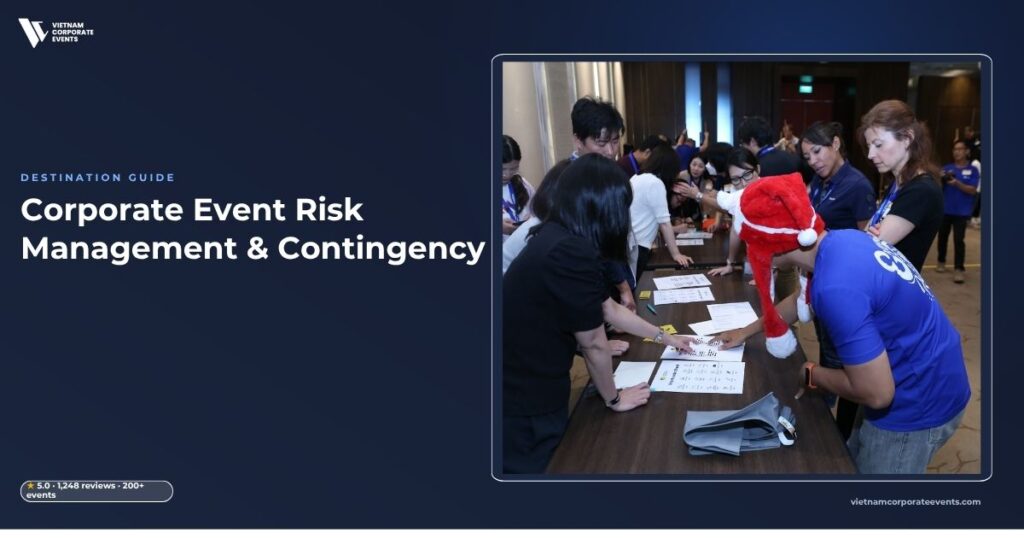
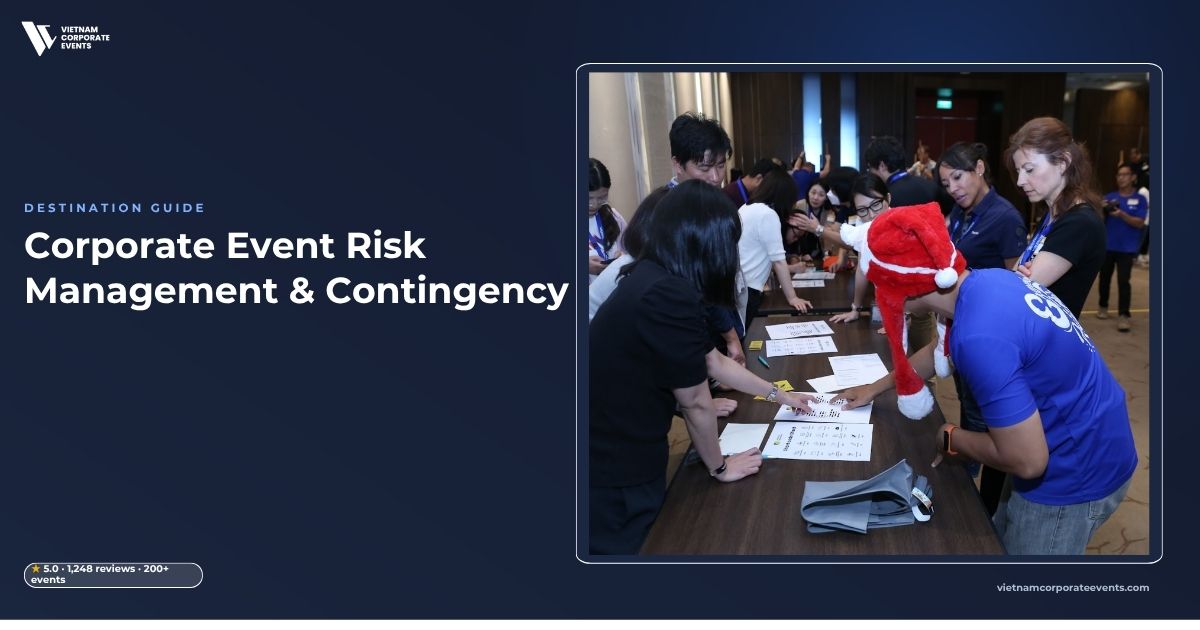
Corporate Event Risk Management & Contingency
Every event that went badly wrong had a plan. What it did not have was a second plan, written down, with a named person authorised to trigger it and a deadline for the decision.
Corporate event risk management is not about anticipating everything. It is about identifying the handful of things that would genuinely derail the event, deciding in advance what happens if they occur, and making sure someone has the authority to act at eleven o’clock at night.
This guide covers risk identification, weather and supplier contingency, medical and safety planning, insurance, and a practical checklist.
What actually goes wrong at corporate events?
Less exotic than risk registers suggest. The recurring failures are mundane:
- Weather affecting outdoor elements — the most common by a wide margin.
- Supplier failure. A no-show, a late arrival, or equipment that does not work.
- Transport delay putting a group behind schedule.
- Technical failure — sound, screens or content.
- Key person absence. A speaker, MC or executive who cannot attend.
- Medical incidents, particularly during physical activities.
- Missing permits discovered late; see our permits guide.
Effective corporate event risk management concentrates on these seven rather than producing a comprehensive register nobody reads. Each has a known mitigation, and the work is deciding it in advance.
How do you assess risk?
Corporate event risk management asks two questions per risk, then makes a decision:
How likely is it, and how bad would it be? A high-likelihood, high-impact risk needs a contracted alternative. A low-likelihood, high-impact risk needs a documented response. Low-impact risks need noting and nothing more.
The practical output is not a matrix. It is a one-page document listing each significant risk, the trigger, the response, the person authorised to decide, and the deadline for deciding.
That last column is what separates event safety planning corporate teams actually use from a document produced for a compliance file.
How do you handle weather?
The dominant risk for any event with an outdoor component, and the one most often left to hope.
The rule is that a wet-weather plan must be contracted rather than identified. Knowing there is a ballroom upstairs is not a plan if it is booked for another event that night; the alternative space has to be held.
Three decisions to make in advance:
- The trigger. What forecast or observed condition activates the alternative.
- The decision point. A specific time — usually four to six hours before doors, since setup takes that long.
- The decision maker. One named person, not a committee.
In Vietnam, regional seasons matter more than a national forecast. Central Vietnam’s wet season differs from the south’s, and an outdoor gala in Da Nang in October carries materially different risk from the same event in March. See our destination guides for seasonal windows.
How do you manage supplier risk?
Corporate event risk management handles suppliers through vetting before, and redundancy during.
Vetting means confirming insurance, licences and safety certification rather than accepting claims, and asking for references from comparable events. A supplier who cannot produce these for a corporate event is a risk regardless of price.
Redundancy means the critical suppliers have backup. Production companies should carry spare microphones and a backup desk; transport should have a reserve vehicle available; the MC should have a named substitute who has seen the run sheet.
Contracts should also specify what happens on non-performance — a cancellation window, a substitution obligation, and liability. See our production company guide for the technical side.
What medical and safety planning is needed?
Corporate event risk management scales medical provision to the activity, with more for anything physical.
For a standard indoor event: a first aid kit, staff who know where the nearest hospital is, an emergency contact list, and awareness of any medical conditions disclosed at RSVP.
For team building and outdoor activities, considerably more — qualified first aid on site, a documented evacuation route, activity providers with current safety certification, appropriate equipment in the right sizes, and a clear opt-out for anyone who should not participate.
Water and adventure activities warrant the highest standard: certified instructors, correct ratios, life jackets in the right sizes, and a weather cancellation policy. See our kayaking guide and canyoning safety guide for what to verify.
What insurance is required?
Three layers, and the gaps between them are where problems sit.
Venue and supplier insurance covers their own operations and equipment. It does not cover your event or your guests.
Event liability insurance covers third-party injury and property damage arising from the event, and is worth holding for anything above a modest size.
Travel and medical insurance for participants, particularly on overseas programmes, covering medical treatment, evacuation and trip disruption.
The gap that catches organisers is an incident during an activity where the provider’s insurance excludes corporate groups, or where an unpermitted element voids cover. Event insurance corporate Vietnam programmes rely on should be checked against the actual activities rather than assumed generic.
How do you build a contingency plan?
One page, distributed, with five columns:
- Risk. What could go wrong.
- Trigger. What condition activates the response.
- Response. The specific alternative, contracted where necessary.
- Owner. Named person authorised to decide.
- Deadline. When the decision must be made.
An event contingency plan longer than a page will not be read on the day. The value is in having decided in advance, not in the documentation.
Distribute it to the venue, suppliers, the MC and the internal team, and hold a five-minute walk-through at the technical rehearsal. See our run sheet guide for how contingency integrates with timing.
What about the run sheet’s role?
The run sheet is a risk management document as much as a schedule.
Every item should have an “if late” note deciding in advance what gets shortened or cut. A CEO who over-runs by nine minutes should not cause an improvised decision — the second trivia round was already designated as the casualty three weeks earlier.
The same applies to technical failure. If the video does not play, does the MC cover with an anecdote, or does the programme move to the next item? Deciding it in the moment produces dead air; deciding it in advance produces a smooth recovery.
Who should be responsible on the day?
One named person with authority, and it should not be the organiser hosting the event.
An organiser greeting guests, managing speakers and running the programme cannot simultaneously monitor risk and make decisions. Assign a separate person — internal or from the operator — whose job is to watch, hold the contingency plan and act.
For larger programmes, this is an explicit role with a radio or phone line to every supplier lead. For smaller ones, it is a designated deputy. Either way, corporate event risk management fails most often because everyone was busy.
What about overseas programmes?
Additional layers, and duty of care becomes a formal question.
For a company trip abroad, management will ask what happens if someone is injured, hospitalised or loses a passport. Having a documented answer — insurance details, emergency contacts, a named on-ground partner, the nearest international-standard hospital — is what gets a programme approved.
The World Health Organization publishes general travel health guidance that is a reasonable baseline for pre-trip briefings on vaccinations, food and water precautions, and regional health considerations.
Practical additions: passport copies held centrally, an emergency contact for every participant, a 24-hour local contact, and a briefing note issued before departure. See our overseas trip planning guide.
How do you handle a cancellation?
Rare, and worth deciding before it is needed rather than during.
The triggers that genuinely force cancellation are a severe weather event, a venue becoming unavailable, or a serious incident affecting the company. Each should have a decision point and an owner, exactly as a weather contingency does.
The financial position is set at contracting. Cancellation terms in venue and supplier contracts vary widely — some venues retain a deposit, others charge a sliding scale by proximity to the date — and these should be read rather than skimmed, particularly for events booked six months out.
Postponement is usually preferable to cancellation and often better supported by contracts. Where a date might move, negotiating a postponement clause at signing costs nothing and is worth considerably more than a refund provision that will never be triggered.
What is the practical checklist?
Ten corporate event risk management items that cover most events:
- Wet-weather alternative contracted, with trigger, deadline and decision maker.
- Supplier insurance and licences verified, not claimed.
- Backup equipment confirmed with the production company.
- Substitute MC identified and briefed.
- First aid provision matched to the activities.
- Emergency contact list on one sheet, held by several people.
- Medical and dietary disclosures collected and acted on.
- Permits confirmed by a specific date; see permits guide.
- “If late” decisions marked on the run sheet.
- A named risk owner on the day, not hosting.
A short example: when a beach gala in central Vietnam faced an unforecast storm four hours before doors, the event moved indoors and started twenty minutes late. It worked because the ballroom had been held on a contingency contract for six weeks, at a fraction of the full rate, and one person had authority to make the call.
Frequently asked questions about corporate event risk management
What usually goes wrong at corporate events?
Weather affecting outdoor elements, supplier failure, transport delay, technical failure, absent key people, medical incidents and permits discovered late.
What makes a wet-weather plan effective?
It must be contracted rather than identified. Knowing there is a ballroom upstairs is not a plan if it is booked – the alternative space has to be held.
When should a weather decision be made?
Usually four to six hours before doors, since setup takes that long, by one named person against a pre-agreed trigger rather than by committee.
What insurance does a corporate event need?
Venue and supplier cover for their operations, event liability for third-party injury and damage, and travel and medical cover for participants on overseas programmes.
What should a contingency plan contain?
One page with five columns – risk, trigger, response, named owner and decision deadline. Anything longer will not be read on the day.
Who should manage risk on the day?
A named person who is not hosting. An organiser greeting guests and running the programme cannot simultaneously monitor risk and make decisions.
What extra planning do overseas programmes need?
Documented duty of care – insurance details, emergency contacts, a named on-ground partner, the nearest international-standard hospital, and a pre-departure briefing.
How does the run sheet help manage risk?
Every item should carry an “if late” note deciding in advance what gets shortened or cut, so an over-running speech does not force an improvised decision.
Plan your event properly
Want corporate event risk management built into the plan rather than added afterwards, with contingencies contracted and owners named? Request a free proposal — or explore our corporate events service and past success stories.