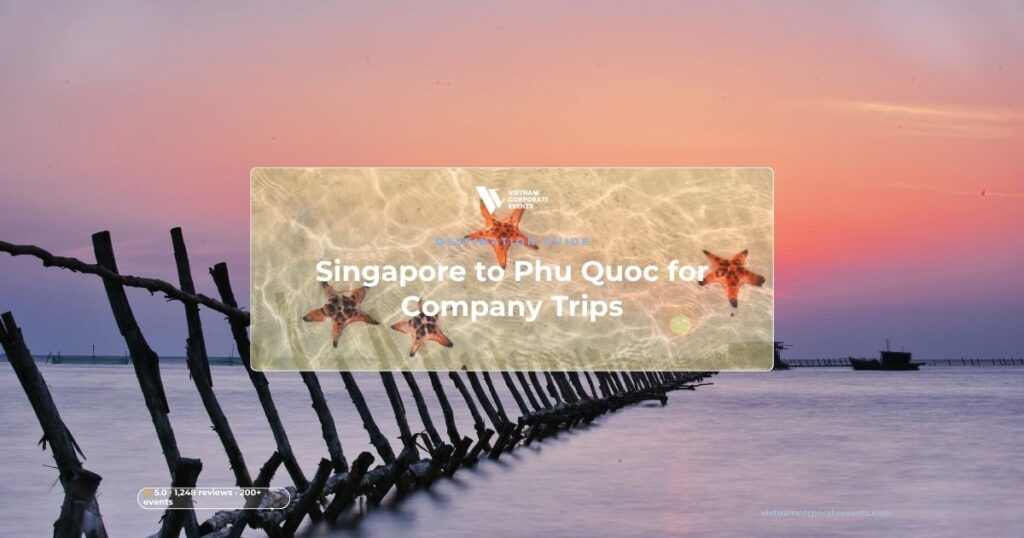
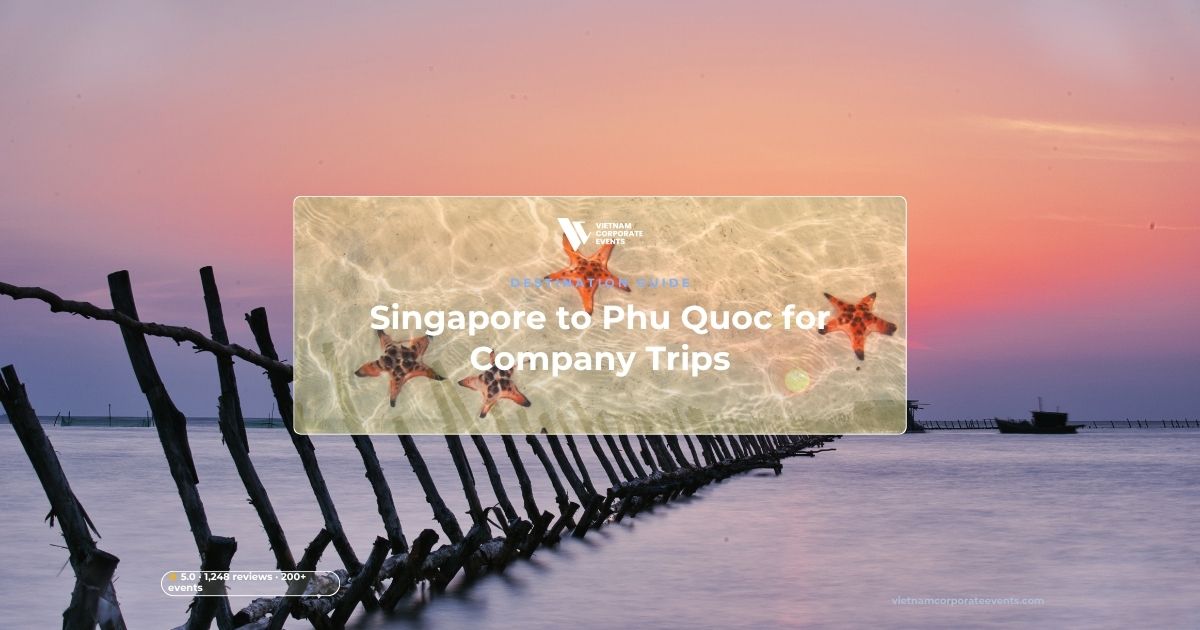
Singapore to Phu Quoc for Company Trips
Most Singapore companies with a mixed-nationality team have had the same conversation: the trip is booked, and then someone realises four colleagues need visas that take three weeks to process. Phu Quoc is the destination where that conversation is shortest.
A Singapore to Phu Quoc company trip combines island exclusivity with a visa position that is unusually straightforward for a regional team, which is a rare pairing in Southeast Asia.
This guide covers flights, the visa advantage, resorts and venues, what to do on the island, group sizes, seasons and cost.
Why Phu Quoc for a Singapore team?
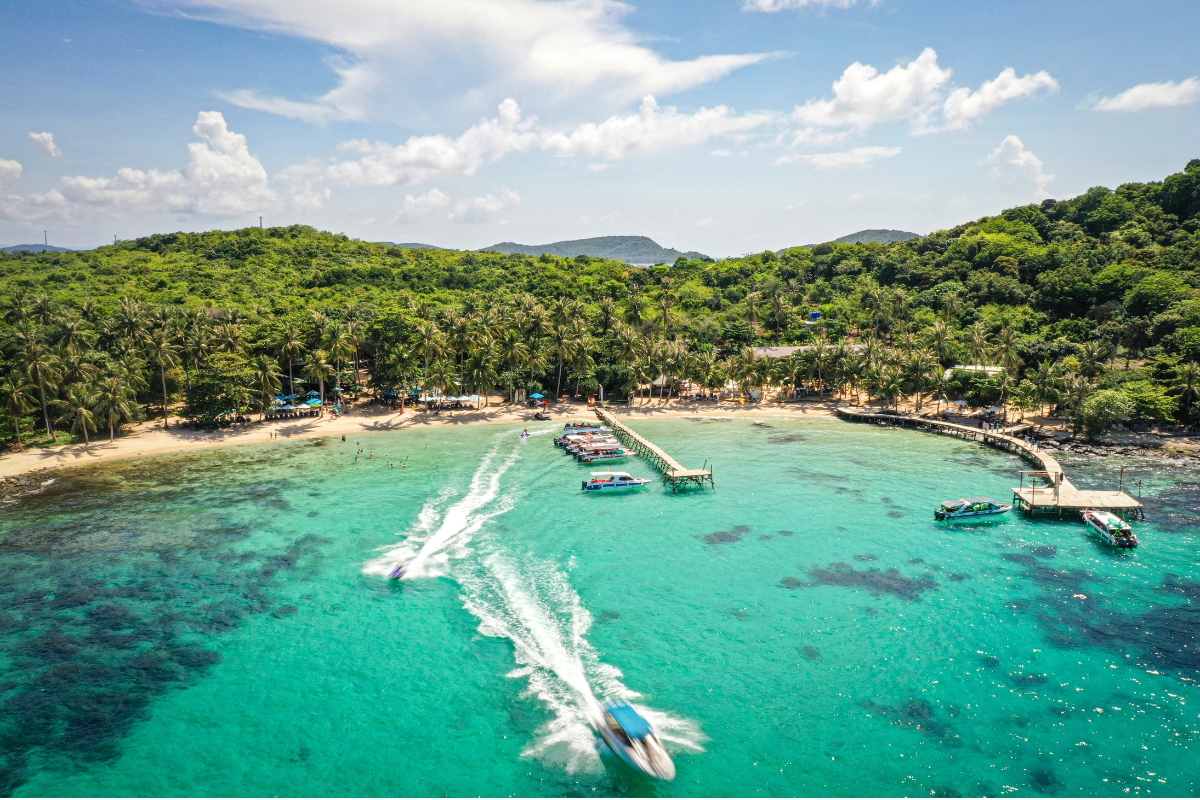
Four reasons make a Singapore to Phu Quoc company trip work, and the first is the one Singapore planners care about most. The SHRM research links shared experience to engagement, and an island delivers that with minimal logistical friction.
The visa position. Phu Quoc has operated a visa exemption policy for international arrivals, which for a Singapore office containing Malaysian, Indian, Filipino, Australian and European passport holders removes a genuine administrative burden. Conditions change, so verify at booking — but the structural advantage is real.
Second, exclusivity. An island reads as a more premium reward than a mainland beach, which matters for incentive and senior-team programmes. Third, resort quality: Phu Quoc’s integrated resorts are among the best in Vietnam.
Fourth, containment. Everything happens on one property or one island, so a Phu Quoc for Singapore companies programme has almost no transfer time eating into the days.
How do the flights work?
Direct services have operated between Singapore and Phu Quoc with a flight time of around two hours, alongside connections via Ho Chi Minh City which add roughly two hours in total.
Route availability varies by season and carrier, so a Phu Quoc Singapore direct service should be confirmed rather than assumed when planning. Where direct flights are not available on your dates, the Ho Chi Minh City connection is straightforward but turns arrival day into a travel day.
For groups above twenty, use an airline group desk. And confirm single-day flight capacity before contracting venues — an island has finite seats, and a 200-person group arriving together is a real constraint.
Where should you stay?
A Singapore to Phu Quoc company trip has a few distinct areas to choose between:
- Long Beach (Bai Truong), west coast. The largest concentration of resorts, sunset-facing, with restaurants and nightlife nearby.
- The north. Large integrated resorts with extensive facilities, quieter and more self-contained.
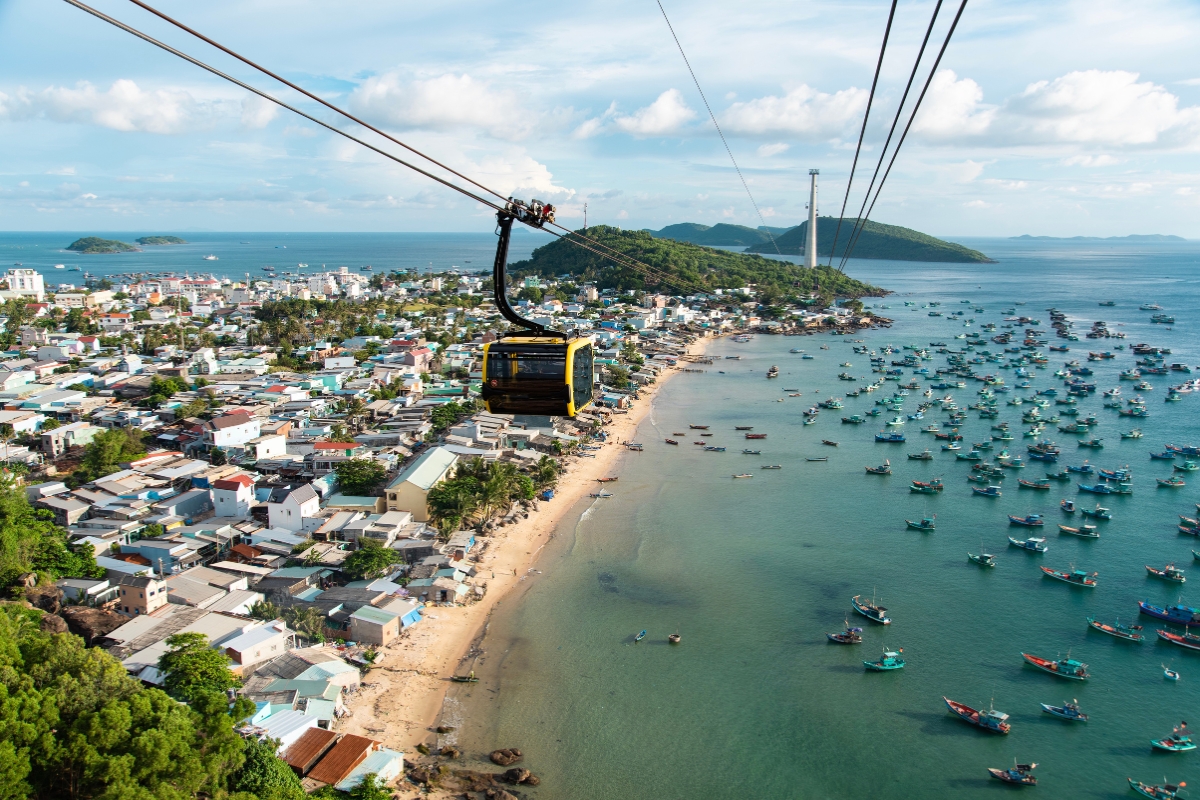
- The south. Near Bai Sao and the cable car, with premium properties and the best beaches; see Bai Sao team building.
- Villa and boutique properties. Scattered across the island for smaller senior groups.
For an SG to Phu Quoc corporate programme, an integrated resort with in-house meeting space, multiple restaurants and a beach is the practical choice — containment removes almost all transfer overhead. See our MICE Phu Quoc guide for venue capacities.
What do you do on the island?
Enough for three days without repetition:
- Beach team building. Olympics, water games and raft races on the southern beaches.
- Island hopping and snorkelling. Boat excursions to the southern islets; see island team building.
- The cable car and theme park. A group excursion with genuine spectacle; see VinWonders corporate trips.
- Kayaking and paddleboarding. Sheltered water suited to mixed ability; see kayaking.
- Night market and pepper farms. Cultural half-days, good for accompanying partners.
- A beach gala. The evening centrepiece, with the sea as the backdrop.
Two activities plus a gala fills three days comfortably. Phu Quoc rewards restraint — the island’s appeal is partly that there is time to sit still.
What group sizes work?
Broader than most island destinations, which is why it works for MICE as well as reward trips.
Small groups of 10 to 40 suit villa buy-outs and boutique properties, with genuine exclusivity. Mid-size groups of 40 to 200 fit comfortably within a single integrated resort, which is the island’s strongest configuration.
Groups of 200 to 500-plus are feasible at the largest properties, but two constraints bind: total room inventory at a consistent standard, and flight capacity for a single-day arrival. Both should be confirmed before venues are contracted.
When should you go?
Phu Quoc’s seasons are well defined and they matter for a beach-led trip.
The dry season runs roughly November to April, with the calmest water, clearest skies and most reliable conditions for boat excursions and beach galas. This is also peak season, with higher rates and earlier booking requirements.
The wetter months from around May to October bring rain in heavy short bursts and rougher seas on parts of the coast. A trip in that window should carry covered backup for outdoor elements and schedule water activities early in the day.
Note that Phu Quoc’s dry season is roughly the inverse of Da Nang’s, which is genuinely useful — whichever quarter a Singapore company needs, one of the two is in season.
What does it cost?
A Singapore to Phu Quoc company trip sits at the higher end of Vietnam’s destinations, and the cost structure reflects an island.
Accommodation and food and beverage price above Nha Trang and slightly above Da Nang for equivalent standards, since supply is shipped in. Flights are comparable to other Vietnamese destinations from Singapore. Activities and production are broadly in line with the mainland.
Against Bali or Phuket at the same resort tier, a Singapore to Phu Quoc company trip generally lands lower, with the visa position as an additional practical saving in administrative time. See our Singapore cost guide and budget guide.
What are the practical constraints?
Worth being straight about, because the island is not right for every brief.
Flight dependency is the main one — a single-day arrival for a large group depends on seat availability that a mainland city does not worry about. Supply costs mean food, beverage and production price higher than on the mainland.
Production capability is thinner than in Ho Chi Minh City, so complex staging may need equipment and crew flown in, which should be quoted explicitly. And weather outside the dry season genuinely affects the boat excursions that are part of the island’s appeal.
For a straightforward working meeting with no experiential requirement, Ho Chi Minh City is cheaper and simpler.
What does a sample itinerary look like?
A three-day, two-night Singapore to Phu Quoc company trip for a team of 60:
Day one. Morning flight from Changi, resort arrival and lunch. An afternoon beach session to mix the group. Welcome dinner at the resort.
Day two. A morning working session or team programme. Island hopping and snorkelling in the afternoon. A beach gala with awards in the evening — the centrepiece.
Day three. Free morning, checkout, afternoon flight home.
The free morning is deliberate and worth defending against pressure to fill it. Phu Quoc for Singapore companies works best when the island itself gets some unstructured time.
What should staff be told before travelling?
One briefing document at four weeks covers most of it, and an island adds a few specifics.
Passport validity of six months, the entry position by nationality, what the company covers versus personal spending, gala dress code, and what to pack — reef shoes for the southern beaches, a light layer for boat mornings, and more sun protection than people expect on white sand.
Add the island practicalities: card acceptance is good at resorts and patchy at the night market, cash is worth carrying, and mobile coverage is reliable in the developed areas and thinner in the north.
What about combining Phu Quoc with Ho Chi Minh City?
A useful option where direct flights are unavailable, and one that turns a routing constraint into a programme feature.
Flying via Ho Chi Minh City allows a night in the city on either end — dinner, a rooftop reception, a city treasure hunt or a Cu Chi day — before the island section. For teams who want both an urban and a beach element, this is more efficient than treating the connection as dead time.
The trade-off is a four-day programme rather than three, and two hotel check-ins rather than one. It suits reward trips and senior groups better than large team-building programmes, where the additional movement adds complexity for limited gain.
See our weekend trips from HCMC guide for the city-side options.
How does it compare with Da Nang?
Both work, and they suit different briefs:
- Phu Quoc for island exclusivity, the visa advantage, containment and a reward-led feel.
- Da Nang for variety across the days — beach, mountain and heritage — and stronger flight connectivity; see Singapore to Da Nang.
For an incentive trip or senior team reward, Phu Quoc reads as more premium. For a team-building programme wanting three genuinely different days, Da Nang has the edge. Seasons also differ, which sometimes decides it outright.
A short example: when a Singapore regional team of 90 with staff from seven nationalities chose Phu Quoc, the deciding factor was neither beach nor budget. It was that the HR manager could book the trip without processing a single visa application, which had consumed three weeks of her time the previous year.
Frequently asked questions about Singapore to Phu Quoc company trips
Why choose Phu Quoc for a Singapore company trip?
The visa exemption position for mixed-nationality teams, island exclusivity that reads as a premium reward, strong integrated resorts, and almost no transfer time.
How long is the flight from Singapore?
Around two hours on direct services where they operate, or roughly four hours in total connecting via Ho Chi Minh City. Confirm current routes when planning.
Does Phu Quoc have visa-free entry?
The island has operated a visa exemption for international arrivals, which is a significant advantage for mixed-nationality teams. Conditions change, so verify at booking.
When is the best time to visit?
The dry season from roughly November to April for calm water and reliable boat excursions. This is also peak season with higher rates and earlier booking.
What group sizes work?
10 to 40 in villas and boutique properties, 40 to 200 within a single integrated resort, and up to 500-plus at the largest properties subject to rooms and flight capacity.
Is Phu Quoc more expensive than the mainland?
Yes for accommodation and food and beverage, since supply is shipped in. Against Bali or Phuket at the same resort tier, it generally lands lower.
What are the practical constraints?
Flight capacity for large single-day arrivals, higher supply costs, thinner production capability than Ho Chi Minh City, and weather affecting boats outside the dry season.
Phu Quoc or Da Nang?
Phu Quoc for island exclusivity, visa simplicity and a reward feel. Da Nang for variety across three different days and stronger flight connectivity.
Plan your Phu Quoc trip
Considering a Singapore to Phu Quoc company trip for your team? Request a free proposal and we will confirm resort availability, flight capacity and the current entry position — or explore our Singapore retreats guide and past success stories.