”
Problem-Solving Team Building Activities That Work
Most team-building games test whether people can have fun together. The useful ones test whether they can think together under pressure — and that is a very different question with a far more uncomfortable answer.
Problem solving team building activities put a group in front of a genuine puzzle with real constraints, then reveal how it actually operates: who speaks, who is heard, who quietly solves the thing while the loudest voice is still talking.
This guide covers fifteen formats that develop real capability, organised by what they build, plus how to choose by group size, how to debrief properly and what they cost.
Why do problem-solving activities beat generic games?
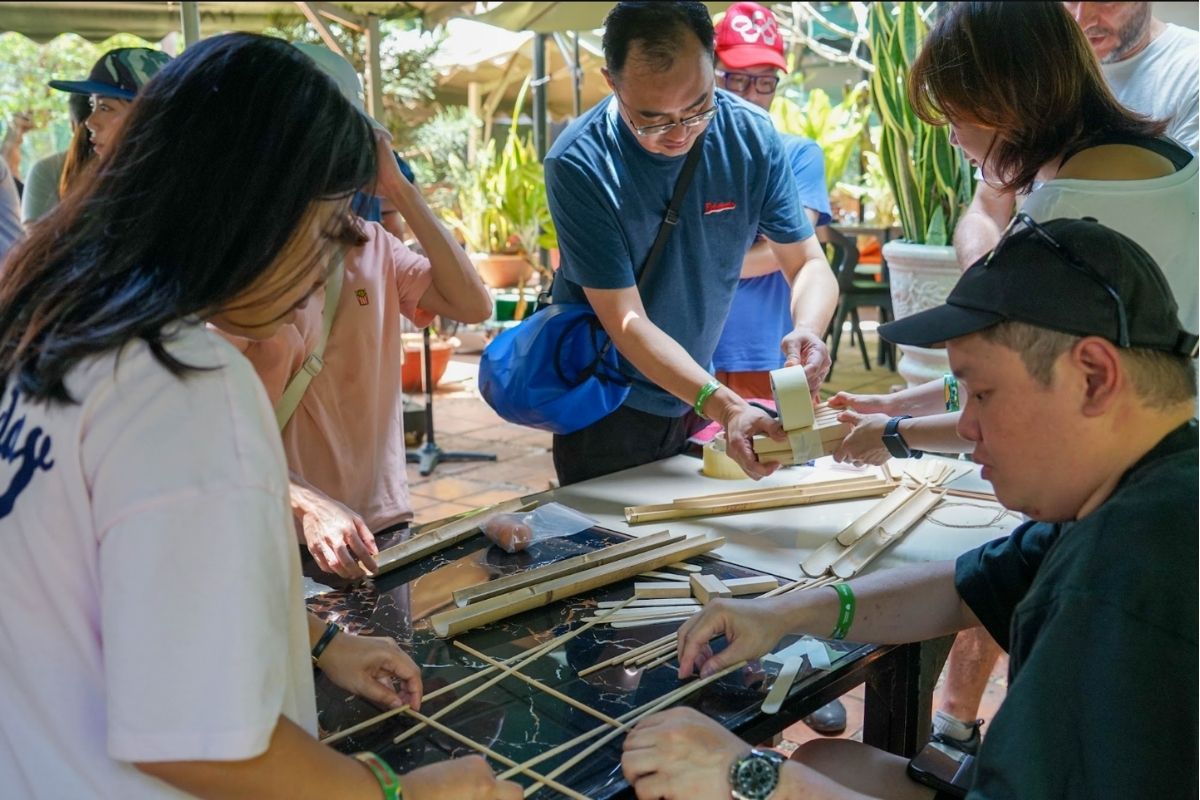
Because they produce evidence rather than atmosphere. A tug-of-war tells you who is strong; a construction challenge with incomplete information tells you how a team handles ambiguity.
That diagnostic quality is the point. Good problem solving team building activities surface the communication patterns a group carries back to work — the interrupter, the bridge-builder, the person with the right answer who never gets airtime.
The SHRM research links structured shared experiences to stronger engagement, and structure is exactly what separates a challenge with a learning outcome from an afternoon of pleasant nonsense.
What are the best construction and build challenges?

Among problem solving team building activities, physical builds are the most reliable category because success and failure are immediately visible:
- Bridge build. Two sub-teams build opposite halves that must meet in the middle — a communication test disguised as engineering.
- Tower challenge. Limited materials, maximum height, a load test at the end.
- Raft build and float. Design under constraint, tested in water; see water team building games.
- Egg drop. The classic protective-container problem with tight material limits.
- Marble run. Sequential construction where each team owns one segment.
These team building challenges work because the constraint does the teaching. Give a group unlimited materials and you learn nothing; give them barely enough and the real dynamics appear within ten minutes.
What are the best puzzle and strategy formats?
These problem solving team building activities reward analysis over action, which suits knowledge teams particularly well:
- Escape room challenges. Sequential locks under a countdown; see escape room team building.
- Murder mystery investigations. Distributed clues that must be pooled to solve.
- Code-breaking missions. Cipher chains requiring systematic delegation.
- Business simulation games. Trading or market scenarios with shifting rules.
- Lost-at-sea ranking exercises. Consensus-building under disagreement.
Strategic team games corporate groups respond to best usually involve incomplete information held by different people, because that forces genuine collaboration rather than parallel individual effort.
What are the best field and outdoor challenges?
Outdoor formats add physical constraint to the mental one:
- Amazing race with problem checkpoints. Puzzles gating progress; see Amazing Race.
- Orienteering and route planning. Navigation as a resource-allocation problem.
- Survival scenario challenges. Shelter, fire and signal tasks with limited kit.
- Blindfolded navigation. Pure verbal-instruction discipline.
- Treasure hunt with logic chains. Clues that must be solved in sequence.
These collaboration games team leaders find most useful tend to be the ones where the group cannot simply out-work the problem — they have to out-think it.
Which activity develops which skill?
Choosing by outcome rather than novelty is what makes a programme defensible to a budget-holder:
- Communication under pressure → bridge build, blindfolded navigation.
- Delegation and role clarity → code-breaking, escape rooms.
- Handling ambiguity → survival scenarios, business simulations.
- Consensus and disagreement → lost-at-sea, ranking exercises.
- Cross-team coordination → marble run, sequential builds.
Matching the format to a specific behavioural objective is the single biggest difference between problem solving team building activities that change something and ones that merely fill a day.
How do you choose by group size?
For problem solving team building activities, capacity constraints bite harder than with physical games, because thinking activities need everyone genuinely involved.
Small teams of 10 to 30 can run a single challenge together, which produces the richest debrief. Mid-size groups of 30 to 100 should split into sub-teams of six to eight competing in parallel — beyond eight people per team, someone always disengages.
Large groups of 100-plus need a tournament structure with identical challenges running simultaneously and a shared leaderboard. The design rule holds at every scale: no team larger than eight, or the quiet members become spectators.
How do you debrief a problem-solving challenge?
This is where the value actually lives, and it is the step most companies skip because everyone is tired and the buffet is open.
Effective debriefs ask specific behavioural questions rather than general ones. Who proposed the plan you used, and how was it chosen over the alternatives? What information did someone hold that reached the group too late? At what point did you stop planning and start building — and was that too early or too late?
The best debriefs then bridge explicitly to work. If a team discovered that its most junior member had the answer twenty minutes before anyone listened, that is a finding about meetings, not about towers.
What makes a problem-solving activity fail?
Four failure modes account for most disappointing sessions, and all are avoidable at the design stage:
- Teams too large. Above eight, participation collapses into spectating.
- Constraints too loose. Ample time and materials remove the pressure that reveals behaviour.
- No debrief. Without reflection, a challenge is entertainment with props.
- Winner-takes-all framing. Heavy competition can suppress the information-sharing you are trying to encourage.
Good facilitation manages all four in real time, which is why problem solving team building activities depend more on the facilitator than on the kit.
Are these activities suitable for senior teams?
Yes, and often more so than physical formats — but the framing has to change.
Senior groups tend to resist activities that feel childish, so the challenge needs genuine intellectual difficulty and a clear link to business behaviour. A business simulation or a complex sequential build lands well; a game with cartoon branding does not.
The other adjustment is psychological safety. Executives are unusually reluctant to be seen failing in front of peers, so the facilitator should frame the exercise as diagnostic rather than competitive, and hold the debrief in a way that examines the system rather than individuals.
Can these run indoors and at short notice?
Yes, which is one of their practical advantages. Most formats need a room, tables and a set of materials rather than a venue, weather window or safety cover.
That makes them the natural fallback when a beach or outdoor programme is rained off, and the obvious choice for a conference break-out or a team day with a modest budget. See our indoor team building activities guide for room-based formats in more detail.
It also means they scale down well. A single afternoon of well-chosen team building challenges work as effectively as a full offsite for a specific development objective.
What do problem-solving activities cost?
Problem solving team building activities are among the most cost-efficient formats available, because the spend goes on facilitation and materials rather than venues, transport or safety cover.
Puzzle and construction challenges are the cheapest. Business simulations and bespoke escape-room builds cost more because the design work is substantial, and outdoor variants add transport and staffing.
The variable worth paying for is the facilitator. Cheap facilitation on problem solving team building activities produces a fun session with no learning, which is the most expensive outcome of all. Model the numbers with our team building cost guide.
A short example: when Meridian Pay ran a bridge build for 48 people, both halves were completed beautifully and did not meet — off by nearly a metre. The debrief question that landed was simple: at what point did you assume the other side was working to the same measurements? Three product managers went very quiet.
How do you sequence a half-day session?
Sequencing matters because cognitive fatigue is real, and a group that has been thinking hard for three hours stops producing useful behaviour to observe.
The reliable structure opens with a short, low-stakes warm-up puzzle to establish the format and get people talking. The main challenge follows while attention is highest, running 45 to 90 minutes with a genuine deadline.
The debrief comes immediately afterwards, while the experience is raw, and a lighter closing activity sends people out on energy rather than analysis. Problem solving team building activities sequenced this way deliver the insight without the exhaustion.
Resist the urge to stack three major challenges into one afternoon — the second is usually weaker than the first, and the third is rarely worth running.
How do you measure whether it worked?
Most companies never check, which is why the same session gets repeated year after year without anyone knowing if it changed anything.
The simplest measure is a short pulse survey a fortnight later asking whether anything from the session has come up in actual work. Vague positive sentiment means it was enjoyable; specific references to the debrief findings mean it landed.
The stronger measure is behavioural. If the team agreed a concrete change during the debrief — a rule about confirming assumptions before starting, or a habit of asking the quietest person first — then check at the next retrospective whether that rule survived contact with a real deadline.
Anything that produces one durable behavioural change has more than justified a half-day.
Frequently asked questions about problem-solving team building activities
What are problem-solving team building activities?
Structured challenges that require a group to analyse, plan and execute under constraints — construction builds, puzzle rooms, strategy simulations and field challenges that reveal how a team actually thinks together.
What is the best problem-solving team activity?
The bridge build is the most reliable diagnostic, since two sub-teams must build halves that meet in the middle, exposing communication gaps immediately and visibly.
How big should teams be?
Six to eight people maximum. Above eight, quieter members reliably disengage and become spectators, which defeats the purpose of the exercise.
Do these activities work for senior leadership teams?
Yes, with adjusted framing. Use intellectually demanding formats such as business simulations, position the session as diagnostic rather than competitive, and debrief the system rather than individuals.
How do you debrief a problem-solving challenge?
Ask specific behavioural questions — who proposed the plan, what information arrived too late, when did planning stop — then bridge those findings explicitly to how the team runs meetings and projects.
Are problem-solving activities suitable indoors?
Most are designed for indoor use, needing only a room, tables and materials. That makes them ideal for conference break-outs and as a weather backup for outdoor programmes.
How long should a problem-solving session run?
Two to three hours including the debrief. The challenge itself often takes 45 to 90 minutes, and the reflection afterwards deserves at least twenty minutes to be worth anything.
Can these activities run alongside a conference?
Yes – they need only a room, tables and materials, which makes them ideal as an afternoon break-out session within a wider conference or offsite agenda.
What is the most common design mistake?
Teams that are too large. Above eight people, quieter members reliably become spectators, and the activity stops producing useful information about the group.
Plan your problem-solving team building session
Ready to find out how your team actually thinks together with problem solving team building activities? Request a free proposal and we will match the challenges and facilitation to your development goals — or explore our team building service and past success stories.
“