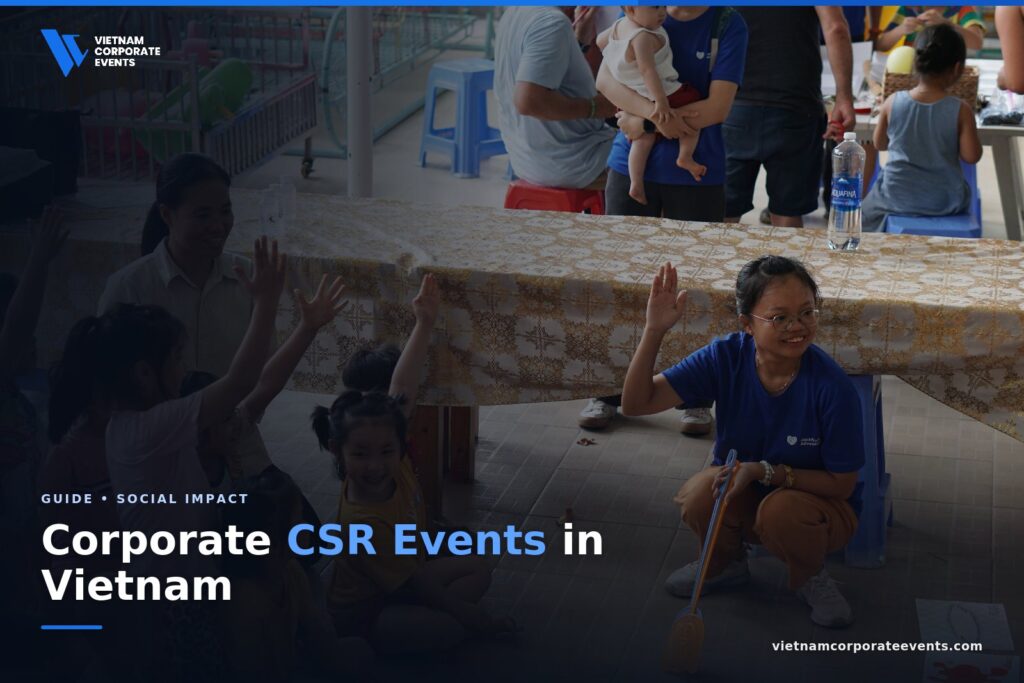
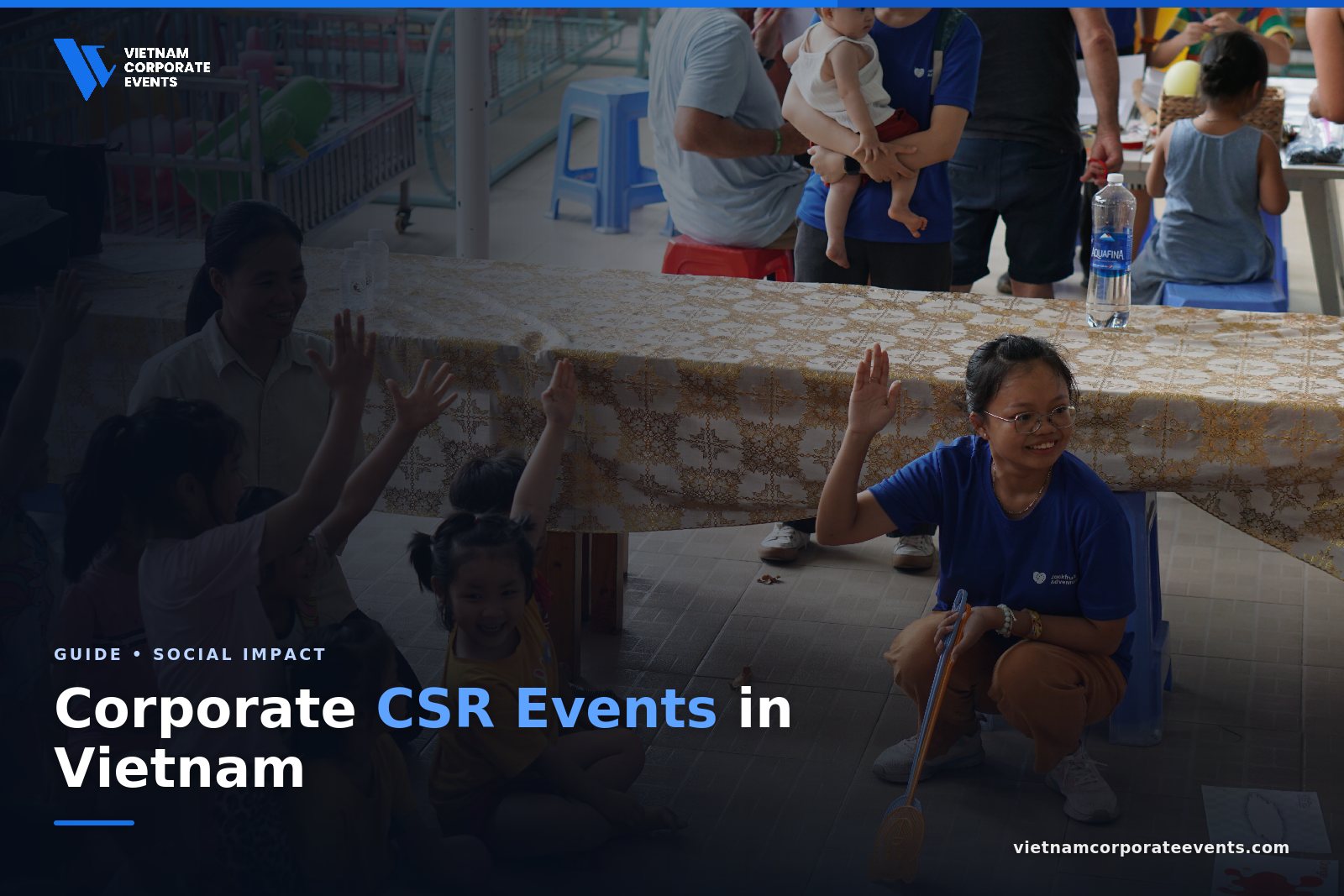
A bad CSR event is easy to spot: a busload of staff in branded T-shirts, a quick photo with a donation cheque, and a community that was more inconvenienced than helped. A great one looks different—and it starts long before anyone shows up to volunteer.
This is a practical, step-by-step guide to running a corporate CSR event Vietnam that actually helps—building your team and your brand while delivering real benefit to a community. Whether it’s a half-day add-on to a conference or a standalone program, the principles are the same. For activity inspiration, pair this with our list of CSR team building ideas.
What counts as a CSR event?
A CSR event is a corporate event built around a social or environmental contribution—volunteering, giving, or sustainability action—often combined with team building. It can stand alone or sit inside a larger program such as an offsite or conference. What defines it is intent: the event exists, at least in part, to create benefit beyond the company itself.
Recognised frameworks can give your program structure and credibility. The international guidance standard ISO 26000 on social responsibility outlines the core areas responsible organisations address, and the UN Sustainable Development Goals offer a shared language—education, poverty, environment—to connect a single event to a global agenda.
Step 1: Define the cause and the goal
Begin with two questions: what cause do we want to support, and what do we want this event to achieve? The cause should connect to your company’s values or industry so the program feels authentic rather than random. The goal should be explicit—stronger team connection, a values moment for staff, a measurable community contribution, or, ideally, all three.
Write the goal down before choosing an activity. It becomes the test for every later decision and the basis for measuring success.
Step 2: Choose the right activity
Match the activity to your cause, your group, and the season. Community kitchens and bike builds run indoors year-round and scale well; environmental work like clean-ups and tree planting depends on weather and location. Make sure the activity is genuinely inclusive, so colleagues of every fitness level and mobility can take part meaningfully.
Crucially, design the activity so the team-building mechanics and the impact reinforce each other. A bike build that’s also a friendly race; a community mural that’s also a collaborative design challenge. When bonding and giving pull in the same direction, both land harder.
Step 3: Partner with the community—properly
This is the step that separates real CSR from theatre. Work through reputable local organisations—schools, charities, social enterprises, community groups—who can tell you what’s genuinely needed and ensure the contribution is wanted and useful. A trusted local partner also handles dignity, consent, and cultural sensitivity, which matter enormously when an event involves vulnerable people such as children.
Authenticity checklist
- Start from genuine, verified community need—not from the activity that photographs best.
- Partner with established local organisations rather than improvising.
- Prioritise the people you’re helping over the camera; get proper consent for any imagery.
- Make the contribution useful beyond the day—durable goods, skills, or restoration that lasts.
- Report outcomes honestly, including what could be done better next time.
Step 4: Plan the logistics and run-of-show
A CSR event has all the logistics of any corporate event, plus a few specific to working in a community setting. Cover the essentials: venue or site, transport and transfers, materials and equipment, catering, safety and first aid, insurance, and a clear weather backup for anything outdoors.
Then build a run-of-show: arrival and briefing, the activity itself with clear roles and timing, the handover or impact moment, and a short reflection to close. The handover—presenting the bikes, serving the meal, unveiling the mural—is the emotional peak; give it time and dignity rather than rushing to the next thing.
Step 5: Brief your team well
People give more when they understand why. Before the event, share the cause, the partner, the goal, and what to expect, so colleagues arrive engaged rather than confused. A good briefing also sets the right tone—respectful, generous, and present—which protects the experience for everyone, especially the community you’re there to support.
Step 6: Run the day
On the day, a named coordinator and enough on-site crew keep things smooth so participants can focus on the contribution, not the logistics. Keep energy up, keep the schedule humane, and protect the impact moment. Capture strong photography and a little video—consented and tasteful—for your report and internal storytelling.
Step 7: Measure and report the impact
Close the loop by measuring both sides. Record the community output (meals served, bikes delivered, kilos collected, families supported) and the team outcome (participation, sentiment, qualitative feedback). Then publish a short, honest report—internally always, externally where appropriate—so the event becomes part of an ongoing CSR story rather than a one-off.
| What to measure | Examples |
|---|---|
| Community impact | Bikes built, meals served, trees planted, waste collected, families reached |
| Team outcome | Participation rate, post-event sentiment pulse, qualitative feedback |
| Brand & story | Photos, video, internal write-up, optional external content |
A quick example
Picture a Japanese manufacturing group—we’ll call them Sakura Components—bringing 120 staff to Vietnam for an annual conference. They added a half-day CSR program: teams shopped at a local market, cooked together at a community kitchen, and shared the meal with residents, then closed with a short reflection.
Because the partner organisation guided what was actually needed, the contribution was genuinely useful, and because the cooking doubled as a team challenge, the bonding was real. The team left talking about the meal they’d shared, not the conference slides. (Illustrative, but it mirrors programs run across the country.)
Common pitfalls to avoid
- Photo-first planning. If the activity is designed around the camera, the community comes second—and everyone can tell.
- Skipping the local partner. Improvised giving often misses the real need and can do more harm than good.
- No reflection. Without a closing moment, the meaning evaporates on the bus home.
- No measurement. Unreported impact can’t build the case for the next program or the broader CSR story.
How much does a CSR event cost?
One of the pleasant surprises of CSR events is that they rarely cost more than a conventional team-building day—and often less, because the budget flows into materials and community partnership rather than entertainment and production. The main cost drivers are group size, the materials involved (bikes, kits, and supplies add up), duration, and any transport to a community site.
Vietnam’s value makes the maths especially favourable: venues, catering, and local sourcing typically cost markedly less than in comparable regional destinations, so a meaningful program is accessible even on a modest budget. As a planning approach, decide the impact you want first—forty bikes, two hundred meals, a restored space—then build the budget backward from there, keeping a small contingency for changes. For a fuller method, see our corporate event budget guide.
CSR event formats by group size
The right format depends heavily on how many people you’re mobilising.
| Group size | Suitable formats |
|---|---|
| Small (10–30) | Skills-based volunteering, community kitchen, orphanage play day, craft support |
| Mid (30–80) | Bike builds, care-package assembly, community murals, learning-kit builds |
| Large (80+) | Multi-station impact races, large-scale clean-ups, coordinated parallel builds |
Whatever the size, the design principle is constant: divide into balanced teams with clear roles so every person contributes, and make sure the team-building mechanics and the genuine contribution reinforce one another.
From one-off to year-round program
A single CSR event creates a great day; a CSR program builds a reputation. The most credible companies treat events as moments within an ongoing commitment rather than isolated gestures. Practically, that means choosing one or two causes to support consistently, repeating and deepening the partnership over time, and reporting cumulative impact—total bikes delivered, total meals served, hours volunteered across the year.
Consistency also compounds the internal benefit: employees come to expect and value these moments, new joiners inherit them as part of the culture, and leadership gains a genuine story to tell stakeholders. Anchoring the program to recognised frameworks like the UN Sustainable Development Goals gives that story structure and credibility over the long term.
Working respectfully in communities
Because CSR events often involve vulnerable people—children, the elderly, communities in need—respect and dignity have to be designed in, not assumed. A trusted local partner is essential here: they guide cultural norms, manage consent, and ensure the contribution is genuinely wanted. Keep imagery tasteful and consented, centre the people you’re helping rather than the brand, and follow the lead of the community and partner on what’s appropriate. Getting this right is not just ethical—it’s what makes the program credible and repeatable.
KPIs and telling your CSR story
To make a CSR event count beyond the day itself, decide upfront which indicators you’ll capture and how you’ll share them. Useful KPIs fall into three buckets: community output (units delivered, meals served, people reached, hours volunteered), team outcome (participation rate, sentiment shift, voluntary repeat interest), and reach (internal engagement with the story, external content performance where relevant).
Then tell the story honestly. Strong, consented photography and a short written recap turn a single afternoon into content that reinforces your culture internally and your brand externally. Lead with the people you helped and the genuine outcome, not the logo; authenticity is what makes a CSR story land rather than feel like marketing. Where it fits, connect the result to a recognised framework so the narrative has structure—an afternoon that contributed to a specific goal reads very differently from a vague feel-good post.
Finally, close the loop with participants. People who gave their time want to know what changed because of it. A brief “here’s what we achieved together” message—numbers, photos, a thank-you from the partner where appropriate—cements the pride and primes the team for the next program. That follow-through is what converts a one-off event into the beginnings of a genuine, ongoing commitment.
Run a meaningful CSR event in Vietnam
We design and deliver authentic CSR programs end to end—trusted community partnerships, real impact, and seamless logistics—so your team gives back without the guesswork.
See our CSR services, browse CSR activity ideas, or use our RFP checklist to brief partners.
Frequently asked questions
How do you run a corporate CSR event?
Define a clear cause and goal, choose a fitting activity, partner with a reputable local organisation, plan logistics and a run-of-show, brief and run the day, then measure and report both community impact and team outcomes.
What is a CSR event?
A corporate event built around a social or environmental contribution—volunteering, giving, or sustainability action—often combined with team building, so a company creates real impact while engaging its people.
How do you keep it from feeling performative?
Start from genuine community need, partner with trusted local organisations, prioritise dignity and usefulness over photos, and report outcomes honestly.
How long does it take to organise?
A half- or full-day activity can come together in a few weeks with a local partner, but four to eight weeks is more comfortable for larger groups and the right community partnership.