Most team-building days are forgotten by the following Monday. The ones people still talk about a year later usually have one thing in common: the team didn’t just play a game—they changed something real for someone else. That’s the quiet power of CSR team building.
CSR team building Vietnam blends a corporate bonding program with a genuine social or environmental contribution, so your team grows closer while a community gains something lasting. This guide explains why it works, walks through twelve give-back activity ideas, and shows how to choose and measure one. If you want the broader picture first, see our social impact and CSR services.
What is CSR team building?
CSR stands for corporate social responsibility—a company’s commitment to operating in ways that benefit society and the environment. CSR team building takes that commitment off the policy page and turns it into a shared, hands-on experience: a team builds bikes for schoolchildren, cooks and serves a meal at a community kitchen, or restores a stretch of mangrove forest, and bonds through the effort.
The difference from ordinary team building is purpose. Instead of competing in a game with no outcome beyond the score, the team works toward something that matters outside the room. The bonding is just as real—arguably more so, because shared meaningful effort builds trust faster than shared entertainment.
Why does CSR team building work so well?
It delivers on three goals at once, which is rare for any single activity.
It deepens connection. People bond more tightly when they work toward a shared purpose than when they simply have fun together. Solving a real problem side by side—often outside everyone’s comfort zone—creates the kind of memory and trust that carries back into the workplace.
It strengthens employer brand and values. Today’s employees, especially younger ones, increasingly want to work for organisations that stand for something. A CSR program signals those values in a way no mission statement can, and it generates authentic content and stories that reinforce your brand internally and externally.
It creates real impact. Unlike a points-based game, a CSR activity leaves something behind: meals served, bikes delivered, a space restored, a family supported. Aligning that impact with recognised frameworks—such as the United Nations Sustainable Development Goals or the principles of the UN Global Compact—lets you connect a single afternoon to a larger commitment.
12 CSR team building ideas that give back
Vietnam is an exceptional setting for purpose-led programs—rich in culture, community, and natural beauty, and full of meaningful ways to contribute. Here are twelve ideas, grouped by the kind of impact they create.
Community & people
- Community kitchen cook-off. Teams shop at a local market, cook together, and share the meal with a community in need—combining culinary teamwork with genuine generosity.
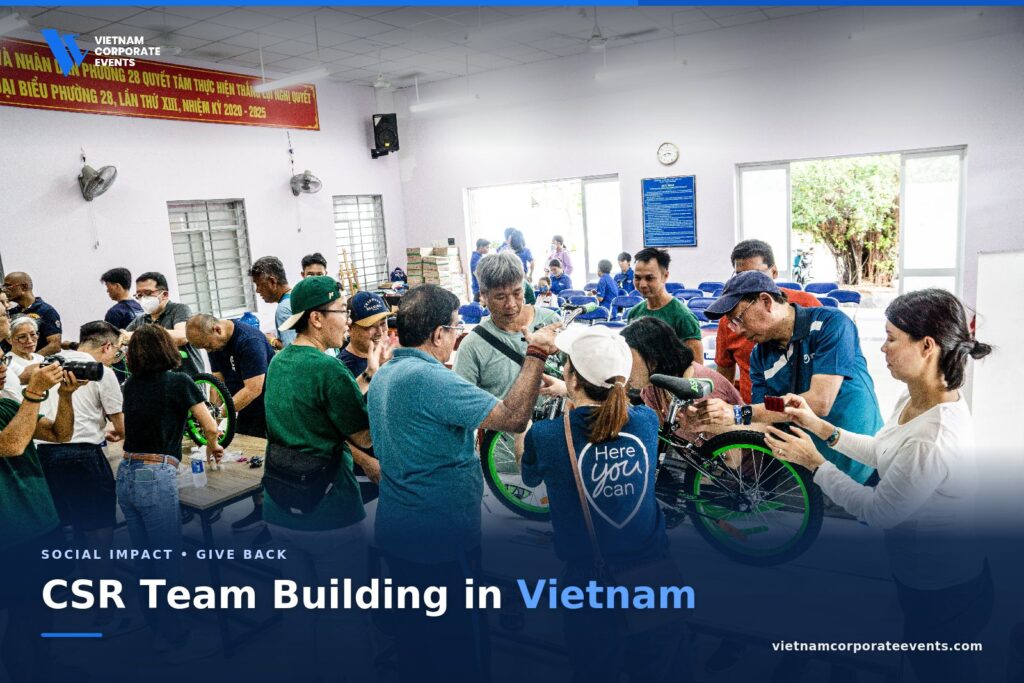
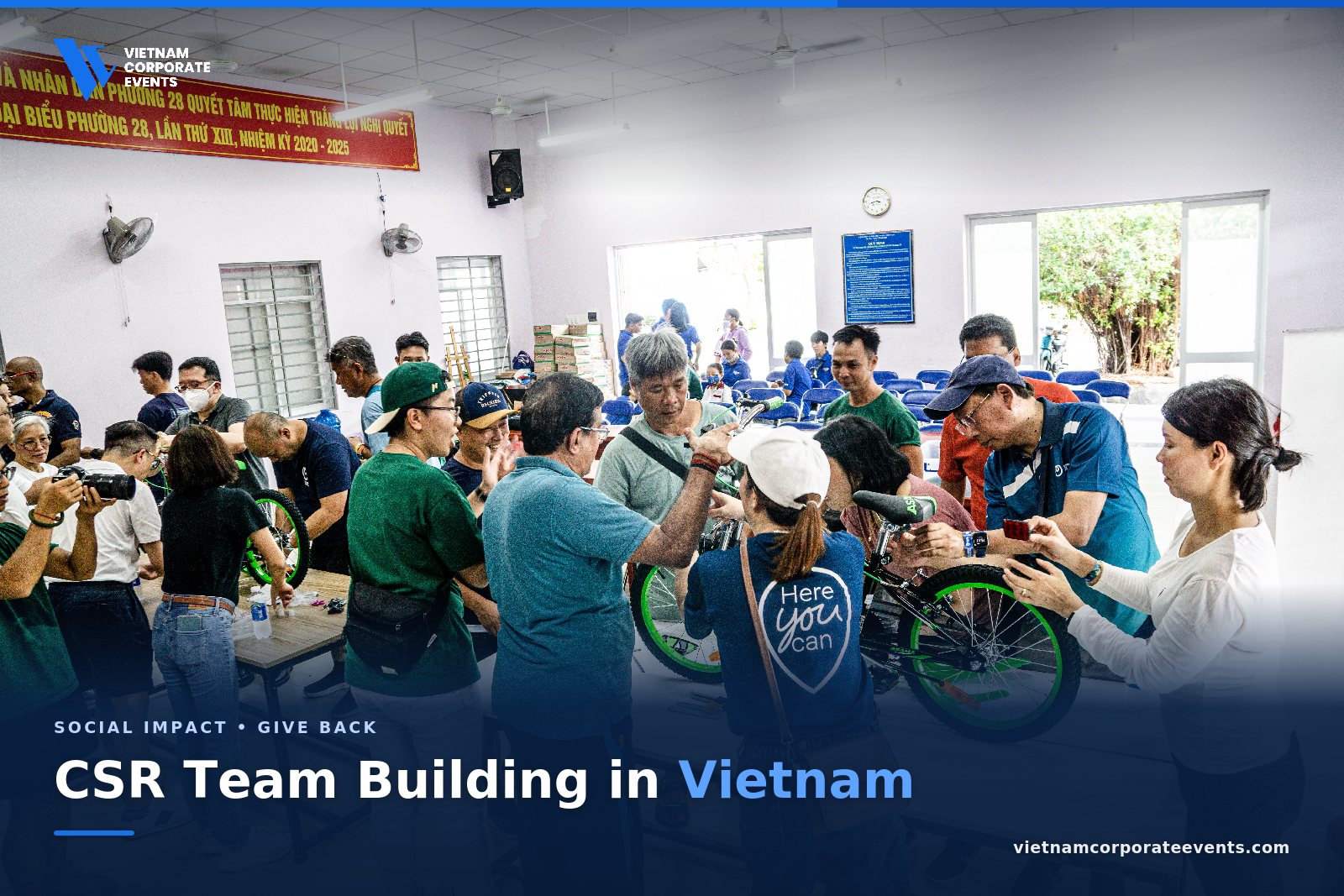
- Bike build for children. Teams assemble bicycles from parts, then present them to schoolchildren who need transport to reach class. The build is a competition; the handover is the reward.
- Care-package assembly. Teams pack and personalise essential-goods kits for families, the elderly, or children, with a quick logistics challenge built in.
- Skills-based volunteering. Your team uses its professional skills—marketing, finance, IT—to help a local social enterprise or NGO, transferring genuine capability.
Children & education
- Orphanage visit & play day. Teams plan and run games, activities, and a shared meal with children, bringing energy and attention as much as resources.
- Learning-kit build. Teams assemble school supplies, books, or STEM kits and deliver them to under-resourced classrooms.
- Library or classroom refresh. A hands-on day painting, organising, and restocking a learning space so it’s brighter and more usable.
Environment & sustainability
- Beach or river clean-up. A coastal or waterway clean-up turned into a friendly, measurable team challenge—weighed and tallied at the end.
- Tree planting or mangrove restoration. Teams plant native trees or mangroves that protect coastlines and store carbon for decades.
- Island or green-space guardianship. A combined clean-up and restoration program on an island or park, leaving the place measurably better.
Culture & legacy
- Community mural. Teams collaborate with local residents to design and paint a mural that celebrates the community and leaves a lasting, visible legacy.
- Heritage or craft support. Teams learn a traditional craft from local artisans and contribute to preserving and promoting it—bonding through culture while supporting livelihoods.
Our signature CSR programs
If you’d rather start from a proven format, our purpose-led programs include the Impact Race, Bike Build Showdown, Heart & Hands, and Island Guardians—each combining real team-building mechanics with genuine community or environmental impact across Vietnam.
How do you choose the right CSR activity?
Start with the cause that fits your company. The activity should connect, even loosely, to your values or industry—an education company supporting classrooms, a logistics firm delivering bikes, a consumer brand running an environmental program. Authentic alignment makes the story credible and the team prouder to take part.
Then weigh four practical factors:
- Group size and mix. Some activities scale to hundreds; others suit intimate groups. Make sure everyone can take part regardless of fitness or mobility.
- Location and season. Outdoor environmental work depends on weather; indoor builds and kitchens run year-round.
- Genuine need. Partner with reputable local organisations so the contribution is wanted and useful—not performative.
- Balance of bonding and giving. The best programs are designed so the team-building mechanics and the impact reinforce each other, not compete.
A quick example: turning a routine offsite into impact
Consider a regional SaaS company—call them Northwind—planning a 90-person offsite in Ho Chi Minh City. Their original brief was a standard half-day of games. Reframed as CSR team building, the afternoon became a Bike Build Showdown: teams raced to assemble forty bicycles, which were then handed to children from a partner school who needed them to get to class.
The mechanics were the same competitive energy as any team-building game, but the outcome was forty children with reliable transport to school—and a team that came away talking about the handover, not the scoreboard. The cost was comparable to their original plan; the meaning was incomparable. (Details are illustrative, but the format mirrors programs run across Vietnam.)
How do you measure the impact?
A CSR program is worth measuring on two axes: what the community gained and what the team gained.
For community impact, capture the tangible output—bikes built, meals served, kilos of waste collected, trees planted, families supported. For team impact, track participation, a short post-event sentiment pulse, and qualitative feedback. Pair both with strong photography and a brief report you can share internally and, where appropriate, externally.
Reporting the result matters. It closes the loop for participants, builds the case for the next program, and—when framed against recognised goals—lets a single afternoon contribute to a credible, ongoing CSR story rather than a one-off feel-good moment.
Bringing it together
CSR team building is one of the few investments that pays back to your people, your brand, and a community at the same time. In Vietnam, where authentic local experiences and strong value come together, it’s also remarkably accessible. Choose a cause that fits, design the bonding and the giving to reinforce each other, partner with reputable locals, and measure both sides of the impact—and you’ll run a day people genuinely remember.
Aligning CSR team building with business goals
The strongest CSR programs aren’t a standalone “nice thing”—they connect to objectives the business already cares about, which makes them easier to fund and repeat.
Engagement and retention. Purpose-led activity speaks directly to belonging and meaning, the deeper drivers of engagement. Teams that feel proud of their employer are more likely to stay, and the cost of replacing skilled staff dwarfs the per-person cost of a CSR day.
Employer brand and recruitment. Candidates increasingly weigh values when choosing where to work. A documented, authentic CSR program gives recruiters real stories to tell, not slogans.
ESG and CSR reporting. When you measure outputs and align them to recognised goals, a single afternoon feeds a credible, ongoing sustainability narrative rather than disappearing as a one-off. That makes the program defensible at budget time and useful to communications and leadership.
Client and partner relationships. Shared CSR activity is a powerful way to deepen relationships with key clients—doing good together builds a different kind of bond than a dinner ever could.
Matching the activity to your group size
Group size changes what’s practical and how the day is structured. Use this as a quick orientation:
| Group size | What works well |
|---|---|
| Small (10–30) | Skills-based volunteering, orphanage play days, intimate community kitchens, craft support |
| Mid (30–80) | Bike builds, care-package races, murals, learning-kit assembly with clear team structures |
| Large (80+) | Multi-station impact races, large clean-ups, and parallel builds run as a coordinated production |
Larger groups need more facilitation and tighter logistics, but they also create more impact and more energy. The key is dividing into balanced teams with defined roles so everyone contributes rather than spectates.
A simple planning timeline
A well-run CSR day rewards a little lead time—mostly to secure the right community partnership.
- 6–8 weeks out: Confirm cause, goal, group size, and budget; engage a reputable local partner to verify genuine need.
- 3–4 weeks out: Lock the venue or site, materials, catering, transport, and a weather backup; finalise the run-of-show.
- 1–2 weeks out: Brief participants on the cause, partner, and what to expect; confirm consent for any photography.
- Event day: Run with a named coordinator and enough crew; protect the handover moment; capture tasteful imagery.
- After: Measure both community output and team sentiment, then share a short, honest report.
Mistakes to avoid
- Designing for the camera. If the activity is built around the photo, the community comes second—and it shows.
- Skipping the local partner. Improvised giving often misses the real need and can do more harm than good.
- Excluding people. Activities that demand high fitness leave colleagues on the sidelines; design for everyone.
- No reflection or report. Without a closing moment and a follow-up, the meaning—and the measurable value—evaporates.
Plan a CSR team building program in Vietnam
From bike builds to beach clean-ups and community murals, we design and run purpose-led programs that bond your team and create real impact—end to end, with a 24-hour response.
Explore our CSR services and team building, or read our guide to purpose-driven team building.
Frequently asked questions
What is CSR team building?
A corporate bonding program combined with a genuine social or environmental contribution—building bikes for children, cooking for a community, restoring a green space—so the team bonds while creating real impact.
Why is it effective?
It works on three levels at once: deeper connection through shared meaningful effort, a stronger values-led employer brand, and tangible benefit to a community. Purpose tends to be more memorable than entertainment alone.
How do you measure impact?
Track both community output (bikes built, meals served, trees planted) and team outcome (participation, sentiment), and capture it with photos, a short report, and a follow-up pulse survey.
Is it expensive?
Not necessarily—often it costs the same as or less than a standard team-building day, because the budget goes into materials and community partnership rather than entertainment. Vietnam’s value makes premium programs accessible.