”
20 Water & Beach Team Building Games
Nothing dismantles a corporate hierarchy faster than getting everyone soaked. A director who has just capsized a raft in front of forty colleagues is, briefly, exactly as ordinary as everyone else — and that is the whole point.
Water team building games use that levelling effect deliberately. They combine physical challenge, laughter and genuine cooperation in a way that dry-land activities rarely match, which is why they anchor most beach and resort programmes in Vietnam.
This guide covers twenty formats organised by setting, plus how to choose by group size and energy level, the safety essentials, costs and how to run them well.
Why do water team building games work?
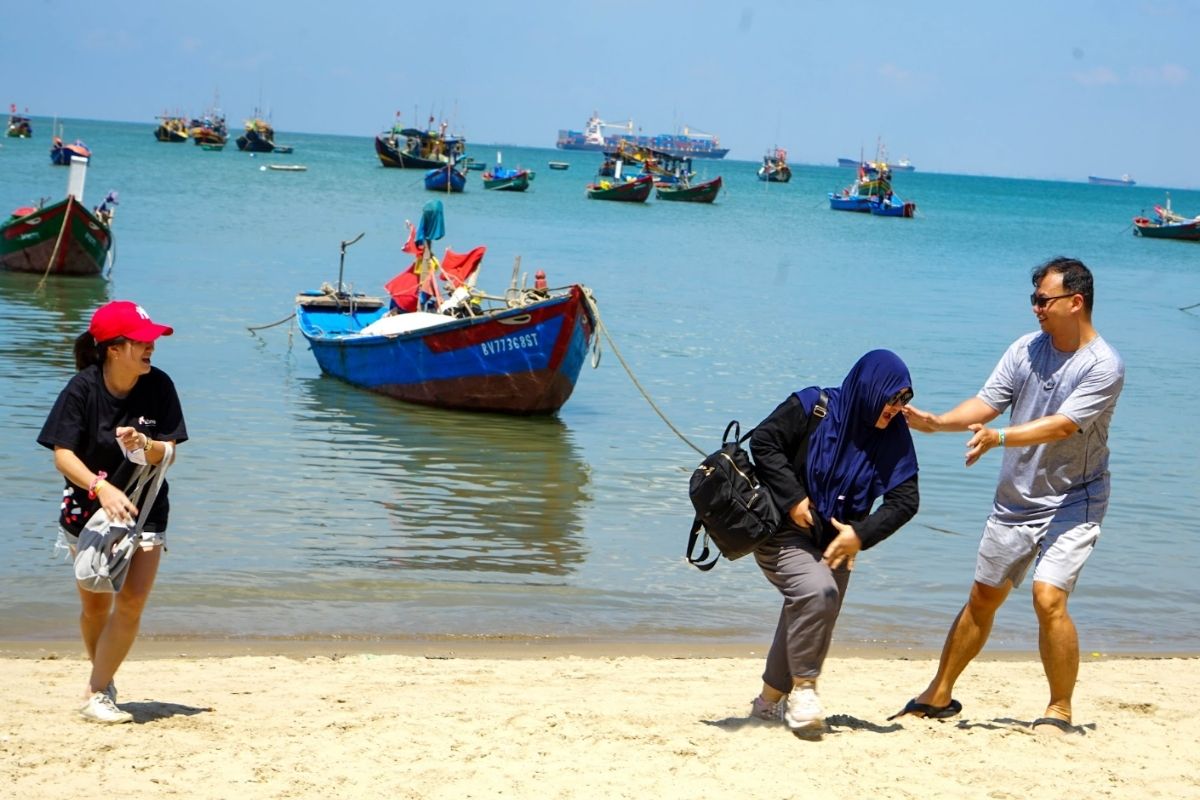
Because water removes the usual advantages. Physical strength helps less than coordination, and the person who is confident in a boardroom is not necessarily the one who is confident in a kayak.
The emotional effect matters as much. Getting wet is inherently informal, so water team building games break down reserve within minutes rather than after an awkward hour of introductions.
Shared mild adversity does the rest. The SHRM research links structured shared experiences to stronger engagement, and few shared experiences are as vivid as a raft race nobody expected to enjoy.
What are the best beach water games?
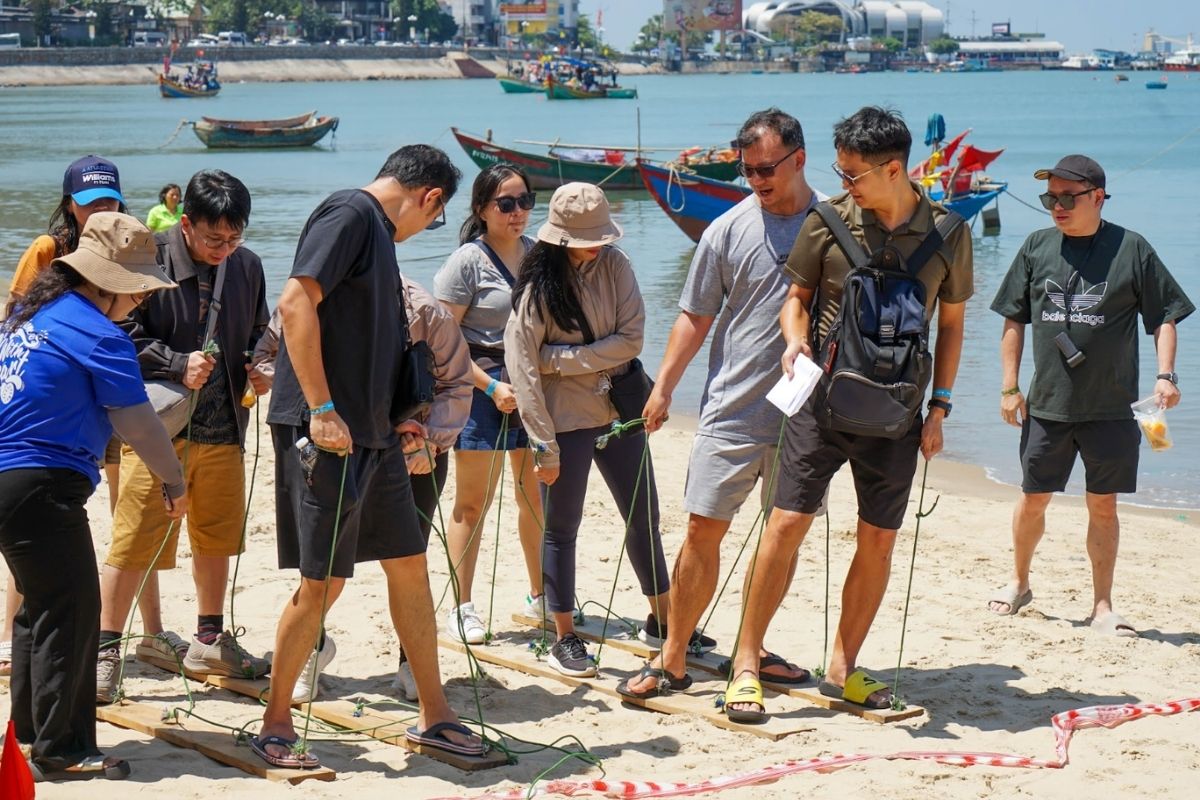
These run in shallow water or on the sand, and suit almost any group. A solid beach team building games list starts here:
- Raft build and race. Teams build a craft from supplied materials, then race it — the classic.
- Water bucket relay. Transporting water across a course with leaking containers.
- Tug-of-war in the shallows. The traditional format, considerably wetter.
- Beach flags. A fast elimination sprint-and-dive game.
- Human wheelbarrow water race. Paired coordination through shallow water.
- Sponge relay. Speed and teamwork moving water between stations.
- Net ball in the sea. A simple, inclusive shallow-water ball game.
These are the backbone of most coastal programmes because they need minimal equipment and scale easily. See our beach team building guide for full programme design.
What are the best open-water and boat games?
These need deeper water, equipment and qualified safety cover, but deliver the strongest memories:
- Kayak races. Paired paddling where synchronisation beats brute force.
- Stand-up paddleboard relays. Balance-based challenges that reliably produce laughter.
- Dragon boat racing. The best large-group water format, demanding total synchronisation.
- Island-hopping challenges. Task-based missions between islands by boat.
- Snorkelling treasure hunts. Underwater retrieval tasks in clear, protected water.
- Raft rescue missions. Scenario-based challenges combining rowing and problem-solving.
- Traditional dugout racing. A cultural variant, strong on lakes such as Lak Lake.
Water sports corporate games like these need a destination with the right conditions, which the planning section covers below.
What pool-based games work at a resort?
When a beach is not available, pool team building activities deliver similar energy in a controlled setting:
- Pool relay races. Simple, inclusive and easy to score.
- Underwater treasure retrieval. Diving for objects against the clock.
- Inflatable obstacle challenges. High-energy and highly photogenic.
- Water volleyball tournaments. A league format for a relaxed afternoon.
- Team float building. Constructing a floating platform that must carry a load.
- Poolside pursuit games. Mixed wet and dry stations around the pool deck.
The advantage of pool team building activities is control — depth is predictable, supervision is simple, and weather matters far less.
How do you choose games by group size?
Capacity is the main constraint, and it differs sharply between formats.
Small teams of 10 to 40 can run almost anything, including kayaking, snorkelling and raft races with everyone participating simultaneously. Mid-size groups of 40 to 150 need parallel stations, so several water team building games run at once with teams rotating between them.
Large groups above 150 need either mass-participation formats such as dragon boat racing and beach relays, or a rotating structure from a shore base. The failure mode at scale is always the same: one spectacular activity, and a hundred and twenty people watching.
How do you match games to your team’s energy?
Not every group wants a full-contact raft race, and forcing it produces resentment rather than bonding.
For high-energy groups, lead with competitive formats — dragon boats, raft races, beach flags. For mixed or reserved groups, start with low-stakes shallow-water relays that get people wet gradually and let momentum build.
For senior or mixed-ability groups, favour skill-based over strength-based games: paddleboard balance challenges and snorkelling hunts reward composure rather than fitness, which keeps everyone genuinely in play.
What safety measures do water activities need?
This is the part that separates professional programmes from risky ones, and it is not optional:
- Qualified lifeguards or safety boats for all open-water activities.
- Life jackets for every participant in deep water, regardless of swimming ability.
- A swimming-ability check collected discreetly in advance.
- Clear weather thresholds for postponing or moving activities.
- A briefed dry alternative so the day survives bad conditions.
Any credible operator volunteers this detail unprompted. Vague safety answers in a proposal are the clearest signal to walk away.
Where can you run water games in Vietnam?
The country’s coastline and lakes give unusual range:
- My Khe, Da Nang. Long beach and calm water minutes from the city; see My Khe team building.
- Phu Quoc. Clear water and island-hopping; see Phu Quoc activities.
- Nha Trang. Sheltered bay conditions ideal for boats and snorkelling.
- Vung Tau. The closest option to Ho Chi Minh City; see Vung Tau team building.
- Mui Ne. Wind sports and kitesurfing tasters; see Mui Ne company trip.
Conditions vary by season, so the destination and date should be chosen together rather than separately.
What do water team building games cost?
Beach and shallow-water formats are among the cheapest activities available, since the venue is free and equipment is simple.
Costs rise with equipment and risk. Kayaks, paddleboards and dragon boats carry rental fees, and qualified safety cover is a necessary line item that should never be trimmed.
Overall, water team building games deliver strong value per unit of budget because the setting does so much of the work. Model the numbers with our team building cost guide.
A short example: when Northwind ran a raft-build-and-race for 90 people on a Vietnamese beach, the winning raft was built by the team with no engineers on it — they simply listened to each other better. The debrief on that point landed harder than any workshop slide.
How do you run a water programme well?
Three practical rules make the difference between a great session and a chaotic one.
Sequence by temperature — hard physical games in the cooler morning, water activities through the hottest hours, social wind-down at sunset. Score everything, since a visible leaderboard turns splashing about into genuine competition.
And build in a dry option. Weather is the one variable nobody controls, so a programme with a briefed alternative never collapses, it simply changes shape.
How do you debrief a water programme?
The debrief is where a wet afternoon becomes a business investment, and it is routinely skipped because everyone is tired and happy.
The most useful questions are specific rather than general. Which team communicated before acting, and which one just started paddling? Who took charge, and was that the person with the most authority or the most relevant skill? What happened when the plan failed halfway through?
Water team building games surface these dynamics unusually clearly, because success and failure are immediate and visible — a raft either floats or it does not.
Twenty minutes of structured conversation while the experience is fresh delivers more than an hour of workshop discussion a week later.
What equipment does a water programme need?
Requirements scale with the format, and a good operator itemises them in the proposal:
- Basic beach formats — buckets, sponges, ropes, flags and marker cones.
- Raft challenges — barrels, planks, rope and lashing materials.
- Paddle sports — kayaks, paddleboards or dragon boats, plus paddles and helmets.
- Safety kit — life jackets, first aid, and a rescue boat for open water.
- Support infrastructure — shade, hydration stations, changing facilities and secure storage.
The last item matters more than people expect. Water team building games work far better when participants have somewhere to change and something dry to put on afterwards.
When should you avoid water activities?
Knowing when not to run them is part of designing a programme properly, and three situations genuinely call for a dry alternative.
The first is conditions — rough seas, storms or strong currents are simply a no, regardless of how much has been paid for the boats. A good operator makes that call early rather than at the water’s edge.
The second is group composition. If a significant proportion of the team cannot swim or is uncomfortable in water, forcing participation creates anxiety rather than bonding, and shallow or land-based formats work better.
The third is timing within the wider programme. Water team building games leave people wet and tired, so scheduling them immediately before a formal dinner or a serious working session is a planning error rather than a bold choice.
Frequently asked questions about water team building games
What are the best water team building games?
Raft build-and-race, dragon boat racing, kayak relays, water bucket relays and snorkelling treasure hunts are the most reliable, combining genuine teamwork with high energy.
Do participants need to swim?
Not for shallow-water and beach formats. Deep-water activities require life jackets for everyone and a discreet swimming-ability check in advance, with alternatives for non-swimmers.
How many people can join water games?
From 10 to several hundred. Small groups run everything simultaneously, mid-size groups rotate between parallel stations, and large groups need mass formats such as dragon boat racing.
What water games work in a pool?
Pool relays, underwater treasure retrieval, inflatable obstacle challenges, water volleyball and team float building all work well, with the advantage of controlled depth and supervision.
What safety cover do water activities need?
Qualified lifeguards or safety boats, life jackets for all deep-water participants, an advance swimming-ability check, clear weather thresholds and a briefed dry alternative.
Are water games suitable for senior teams?
Yes, when you favour skill over strength. Paddleboard balance challenges and snorkelling hunts reward composure rather than fitness, keeping mixed-ability groups genuinely involved.
What happens if the weather turns?
A well-planned programme switches to its briefed dry alternative rather than cancelling, which is why every credible proposal includes an indoor or land-based backup.
How long should a water session run?
Two to three hours is the sweet spot for a multi-game session. Beyond that, sun exposure and fatigue start eroding the energy that makes these formats work.
Can water games be combined with land activities?
Yes, and the strongest beach programmes do exactly that – land-based games in the cooler morning, water formats through the hottest hours, then a social close at sunset.
Plan your water team building programme
Ready to get your team into the water with water team building games that actually build a team? Request a free proposal and we will design the games, safety plan and destination around your group — or explore our team building service and past success stories.
“