What is a corporate treasure hunt?
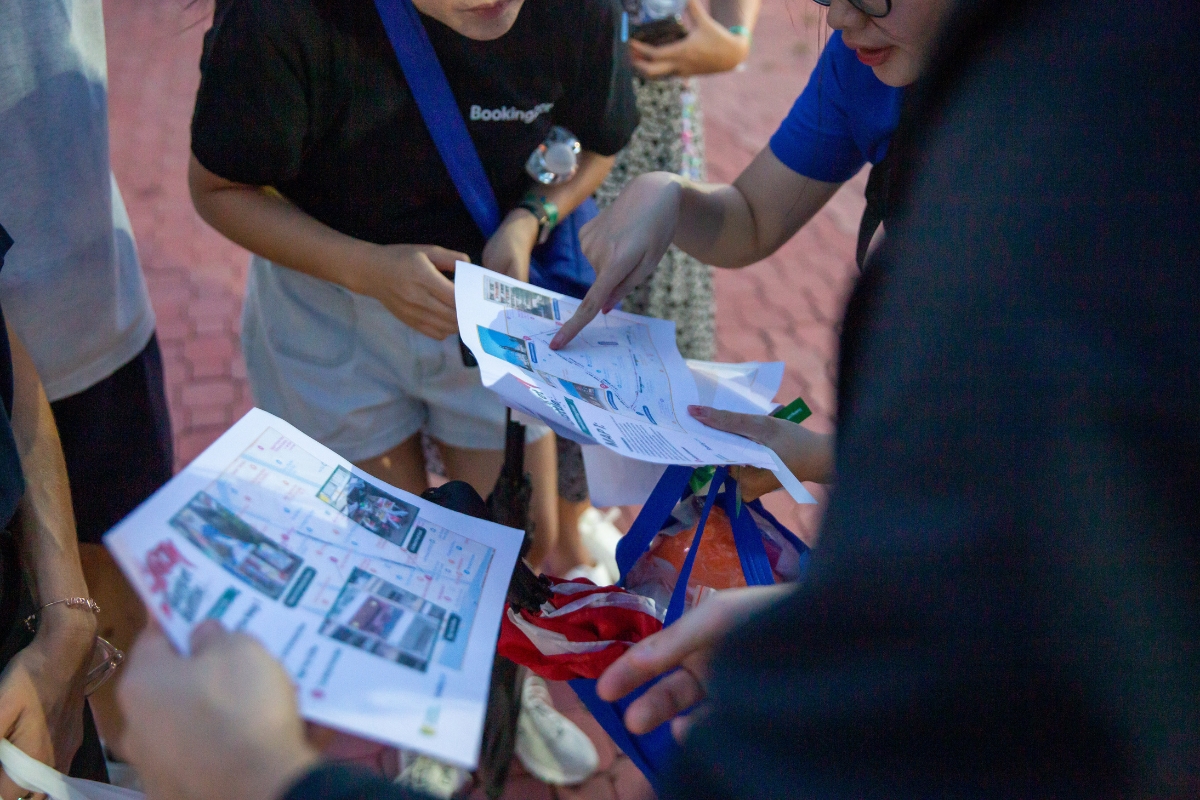
A corporate treasure hunt is a timed, clue-based challenge where teams solve riddles, complete tasks and collect items or answers across a defined area. Points come from both speed and the quality of what they do at each stop.
It sits close to a scavenger hunt team building format, with one difference of emphasis: a treasure hunt leans on sequential clues and problem-solving, while a scavenger hunt leans on collecting and completing a checklist. Most of our programs blend the two.
The magic is in the constraints. A countdown forces fast decisions, limited clues force communication, and varied tasks force teams to use every member’s strengths — nobody wins a corporate treasure hunt Vietnam challenge alone.
How does a corporate treasure hunt work?
The mechanics are simple, which is exactly why they work:
- Briefing. Teams form, receive rules, a kit and the first clue.
- Clue-solving. Each clue points to the next location — a landmark, market stall or resort spot.
- Tasks. At each checkpoint, teams complete a challenge to earn points and unlock the next clue.
- Racing. Groups move between points on foot, by cyclo, or around a venue.
- Scoring and debrief. A leaderboard combines speed and task points, then a facilitator ties it back to teamwork.
That final debrief is what turns a fun chase into genuine team bonding — the reflection is where the lesson lands.
8 corporate treasure hunt ideas for Vietnam
Match the route to your objective and setting. These eight are our most-requested formats:
- City treasure hunt corporate route. A clue trail through a real city centre — the classic urban format.
- Market challenge. Riddles and bartering tasks inside a bustling local market.
- Photo and video hunt. Teams complete creative challenges captured on camera.
- Cultural heritage hunt. Clues built around temples, museums and historic streets.
- Resort or hotel hunt. A self-contained version for conferences and offsites.
- Beach treasure hunt. A coastal edition mixing clues with beach tasks; see our beach team building menu.
- CSR treasure hunt. A hunt that ends with donated goods for a cause; see our CSR team building options.
- Tech-enabled app hunt. A GPS or QR-code hunt for large, dispersed groups.
For a faster-paced, race-format cousin, compare our Amazing Race team building guide, and for the full menu of formats, our team building games ideas pillar.
Where can you run a corporate treasure hunt in Vietnam?
Almost anywhere, which is part of the appeal. The best settings pack landmarks, culture and walkable streets close together.
- Ho Chi Minh City — District 1’s markets and landmarks; see our Saigon team building activities.
- Hanoi — the Old Quarter’s 36 streets; see our Hanoi team building activities.
- Da Nang and Hoi An — beach-to-heritage routes; see our Da Nang team building activities.
- Resorts and islands — self-contained hunts for offsites and conferences.
What group sizes suit a corporate treasure hunt?
This is one of the most scalable formats there is. Small teams of 15 to 40 run a single tight route. Mid-size groups of 50 to 150 split into 8 to 20 teams on the same course with staggered starts.
For 150-plus, an app-based hunt with multiple routes feeds one grand finale. Because teams move independently, a corporate treasure hunt Vietnam program rarely creates the bottlenecks that plague station-based games — which is why it scales so gracefully.
What does a corporate treasure hunt cost?
Pricing depends on route complexity, duration, checkpoints and group size, with per-person rates falling as headcount rises. A half-day city hunt is one of the better-value team-building formats, since the “”venue”” — the city — is free.
Adding an app platform, elaborate tasks or a gala finale raises the cost. A local organiser quotes by objective and headcount rather than a flat figure. To budget it inside a wider program, use our company trip budget guide.
Why does a treasure hunt build better teams?
Because it mirrors real work. Teams get incomplete information, a deadline and a mix of tasks nobody can master alone, so they delegate, communicate and adapt in real time.
Research bodies such as SHRM consistently link shared, active experiences to stronger engagement. A treasure hunt compresses a quarter’s worth of collaboration lessons into an afternoon — provided the debrief makes the link explicit.
A short example: when Lumera ran a city treasure hunt corporate challenge across District 1, the winning team was not the fastest but the one that split into pairs to solve clues in parallel. In the debrief, that became a lasting metaphor for how they tackled projects: divide, trust, reconverge.
Treasure hunt or scavenger hunt: which should you choose?
The terms overlap, but the emphasis differs. A treasure hunt is clue-led and sequential — teams follow a trail. A scavenger hunt team building format is checklist-led — teams collect items or complete tasks in any order.
| Aspect | Treasure hunt | Scavenger hunt |
|---|---|---|
| Structure | Sequential clues | Open checklist |
| Skill | Problem-solving | Resourcefulness |
| Pace | Guided trail | Free-roaming |
Choose a treasure hunt for a guided, puzzle-led experience, and a scavenger hunt for a looser, more creative one. Many of our programs blend both for variety.
How do you design a great corporate treasure hunt?
The best hunts are engineered, not improvised. Four design choices separate a memorable corporate treasure hunt Vietnam program from a confused wander around a city block.
- Vary the clue types. Mix riddles, photo tasks, cultural challenges and physical tasks so every personality contributes.
- Anchor clues to real places. Landmarks and markets make the hunt a discovery, not just a puzzle.
- Balance speed and quality. Score task quality as well as time, so the fastest team is not automatically the winner.
- Keep routes safe and walkable. Position facilitators at key checkpoints for support and scoring.
Get those right and the hunt runs itself on the day. The craft is in the design, which is exactly what a professional organiser brings to a corporate treasure hunt Vietnam program.
Is a treasure hunt for team building or just fun?
Done casually, a hunt is a fun afternoon. Done with intent, it is genuine team development — the difference is the debrief. A facilitated corporate treasure hunt Vietnam program ties what happened on the route back to how the team works.
Watch who navigates, who solves, who keeps morale up when a clue stumps everyone, and the hunt becomes a mirror of the team’s real habits. That reflection is where a treasure hunt team bonding session earns its budget, turning entertainment into insight.
How do you measure the success of a treasure hunt?
Measure it on three levels. Immediately, capture energy and enjoyment. In the following weeks, watch for the behaviours the hunt rehearsed — faster delegation, clearer communication, more cross-team trust.
Over a quarter, track whether engagement holds. A well-run corporate treasure hunt Vietnam program is designed so its lesson transfers, which is what makes a half-day worth the investment rather than just a pleasant break from the office.
What makes a corporate treasure hunt unique in Vietnam?
Plenty of countries run treasure hunts, but Vietnam gives the format a richness few can match. Dense, walkable city centres put clues close together, vibrant markets make unforgettable checkpoints, and the culture — food, craft, history — gives tasks real substance rather than generic filler.
A hunt through District 1, the Hanoi Old Quarter or Hoi An doubles as a cultural discovery, so the team bonds and experiences the destination at the same time. That dual payoff is why a corporate treasure hunt Vietnam program appeals to visiting international groups as much as local teams.
Local facilitation is the other half. Bilingual facilitators who know the streets adapt on the fly, and their knowledge of safe, interesting routes is what turns a good idea into a smooth day. It is the difference between a professional corporate treasure hunt Vietnam program and a well-meaning but chaotic afternoon.
Do you need an app to run a treasure hunt?
Not always — but for larger or dispersed groups, a GPS or QR-code app adds real value. It tracks scores live, unlocks clues automatically, and lets dozens of teams roam different routes without a facilitator at every corner.
For smaller groups, a paper-and-envelope format keeps things simple, tactile and low-cost, and many teams prefer the analogue feel. The right choice depends on group size and how much of the city you want to cover.
Either way, the technology is a tool, not the point. A well-designed route and a sharp debrief matter far more than the platform — a great hunt on paper beats a dull one on an app every time.
Frequently asked questions about a corporate treasure hunt in Vietnam
How long does a corporate treasure hunt take?
Most run two to four hours, plus a debrief and awards. Half-day formats are the most popular for a corporate treasure hunt Vietnam program.
Is a treasure hunt suitable for large groups?
Yes — it is one of the most scalable formats, running from 15 people to 300-plus using staggered starts or an app-based multi-route setup.
Can we run a treasure hunt indoors or in a resort?
Yes. Hunts adapt to hotels, resorts, malls and museums, making them a reliable all-weather choice for conferences and offsites.
What cities are best for a corporate treasure hunt in Vietnam?
Ho Chi Minh City, Hanoi, Da Nang and Hoi An all offer landmark-rich, walkable routes ideal for a city treasure hunt.
Do participants need to be fit?
No. Routes and tasks are designed for mixed fitness levels, and teams choose how they tackle each challenge.
Run your corporate treasure hunt
Ready to turn a city into a team challenge with a corporate treasure hunt in Vietnam? Request a free proposal and we will design a route around your goal, group size and setting — or explore our team building service and past success stories.
“