”
Corporate Party Planning in Vietnam: A Checklist
Nobody remembers the party that ran perfectly. Everybody remembers the one where the food arrived cold at nine, the microphone squealed through the CEO’s speech, and half the team left before the awards.
Corporate party planning Vietnam work is unglamorous by nature — it is a logistics exercise wearing a party hat. Get the sequence, the catering throughput and the run sheet right and the atmosphere takes care of itself.
This guide is the practical checklist: timeline, budget, venue, catering, entertainment, programme design and the details that most often get missed.
What should you decide first?
Three corporate party planning Vietnam decisions shape everything else, and taking them in order saves weeks. The SHRM research links recognition and shared experience to stronger engagement, which is why the programme matters more than the styling.
First, the occasion and tone. A year-end gala, a team celebration and a client-facing party are different events with different guest expectations, and blending them usually satisfies nobody.
Second, the guest list — headcount, whether partners are included, and whether clients or partners attend alongside staff. This determines venue and budget more than any styling choice.
Third, the budget per head. Corporate party planning Vietnam decisions cascade from this number, and discovering it after venue shortlisting wastes effort.
What timeline should you work to?
Working backwards from the date:
- 4 to 6 months out. Date, budget and headcount agreed. Venue shortlisted — earlier for year-end season.
- 3 months out. Venue contracted, theme and concept agreed.
- 2 months out. Catering menu, entertainment and AV booked.
- 1 month out. Invitations issued, RSVPs tracked, dietary needs collected.
- 2 weeks out. Run sheet complete, seating plan set, awards content finalised.
- Week of. Final numbers to the venue, technical check, briefing for anyone with a role.
Year-end season compresses everything. Popular venues for December and the pre-Tet period are frequently booked a year ahead, so an office party organizer Vietnam working on a year-end event should treat venue availability as the constraint that sets the date.
How do you build the budget?
Corporate party planning Vietnam budgets follow a fairly stable structure:
- Venue and catering. Usually 50 to 60 percent of the total.
- Entertainment. Band, DJ, MC or performers.
- AV and production. Sound, lighting, screens and a technician.
- Decoration and theming. Where a strong venue saves considerable money.
- Awards, gifts and prizes. Often under-budgeted relative to their impact.
- Photography. The asset that outlasts the evening.
- Contingency. Ten percent, genuinely reserved.
The highest-return line is usually the MC and sound, not the decoration. A well-run programme in a plain room beats a beautifully styled event where nobody can hear the speeches.
How do you choose the venue?
Corporate party planning Vietnam venue selection has different priorities from a conference:
- Room proportions. A space sized for 400 hosting 200 feels empty no matter what you hang on the walls.
- Kitchen plating capacity against your actual guest count — the single most overlooked check.
- A separate reception area so guests are not standing in the room they will later dine in.
- Dance floor and staging positioned so the programme works.
- Sound limits and curfew. Particularly at rooftop and outdoor venues.
- Accessibility and transport. How guests get there and home afterwards.
See our venue guides for Ho Chi Minh City, Hanoi and rooftop venues, plus non-hotel options for something with more character.
What company party ideas actually work?
Format matters more than theme. These are the structures that reliably land:
- The gala dinner. Seated, formal, built around awards and speeches; see gala theme ideas.
- The standing reception. Circulation over seating — better for networking and mixing.
- The themed party. Costume or concept-led, strongest for informal cultures.
- The outdoor or beach party. Relaxed and photogenic, weather permitting.
- The day-and-night programme. Team activity by day, celebration by night.
Among company party ideas, the day-and-night combination consistently produces the best atmosphere, because people arrive at the evening already relaxed and mixed rather than filing in from the office.
How do you handle catering?
Catering is where corporate party planning Vietnam most often fails, and the failures are predictable.
Match the service style to the format: plated service for seated galas, buffet or stations for standing receptions, and roaming canapés for pure networking events. Mixing formats — a buffet for a seated gala — creates queues and dead time.
Confirm plating capacity explicitly. A venue that seats 400 but plates comfortably for 250 will serve a slow, cooling meal, and the guests at the back will notice.
Collect dietary requirements at RSVP and confirm them with the kitchen rather than simply passing them on. Vegetarian, vegan, halal and allergy requirements should arrive at the table without the guest having to explain themselves.
How do you programme the evening?
Sequence determines energy in corporate party planning Vietnam, and the reliable pattern is consistent:
- Reception (45 minutes). Drinks and mingling while stragglers arrive.
- Welcome and opening (10 minutes). Short, warm, sets the tone.
- Dinner service. Speeches between courses rather than all at once.
- Awards and recognition. The emotional peak, placed while attention is high.
- Entertainment. Performance or headline act.
- Social and dancing. The unstructured close.
The most common programming error is putting speeches too late. By the time dessert has cleared and the bar has been open two hours, no speech lands — good corporate party planning Vietnam practice front-loads the formal content.
What entertainment options work?
Entertainment should match the culture rather than the budget:
- A professional MC. The single highest-impact booking — a good MC saves a mediocre programme.
- Live band or DJ. Band for atmosphere during dinner, DJ for the later social.
- Cultural performance. Traditional music or dance, effective for international guests.
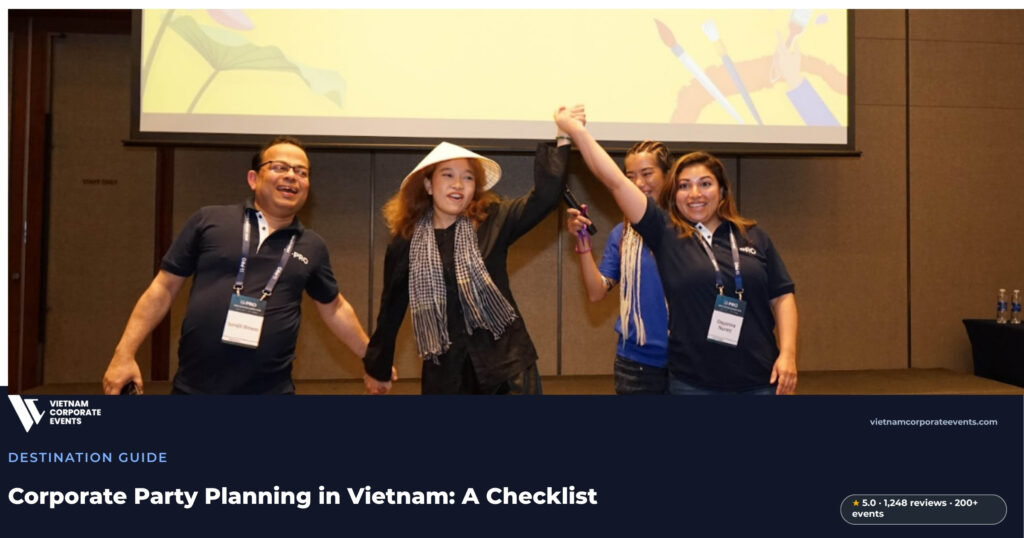
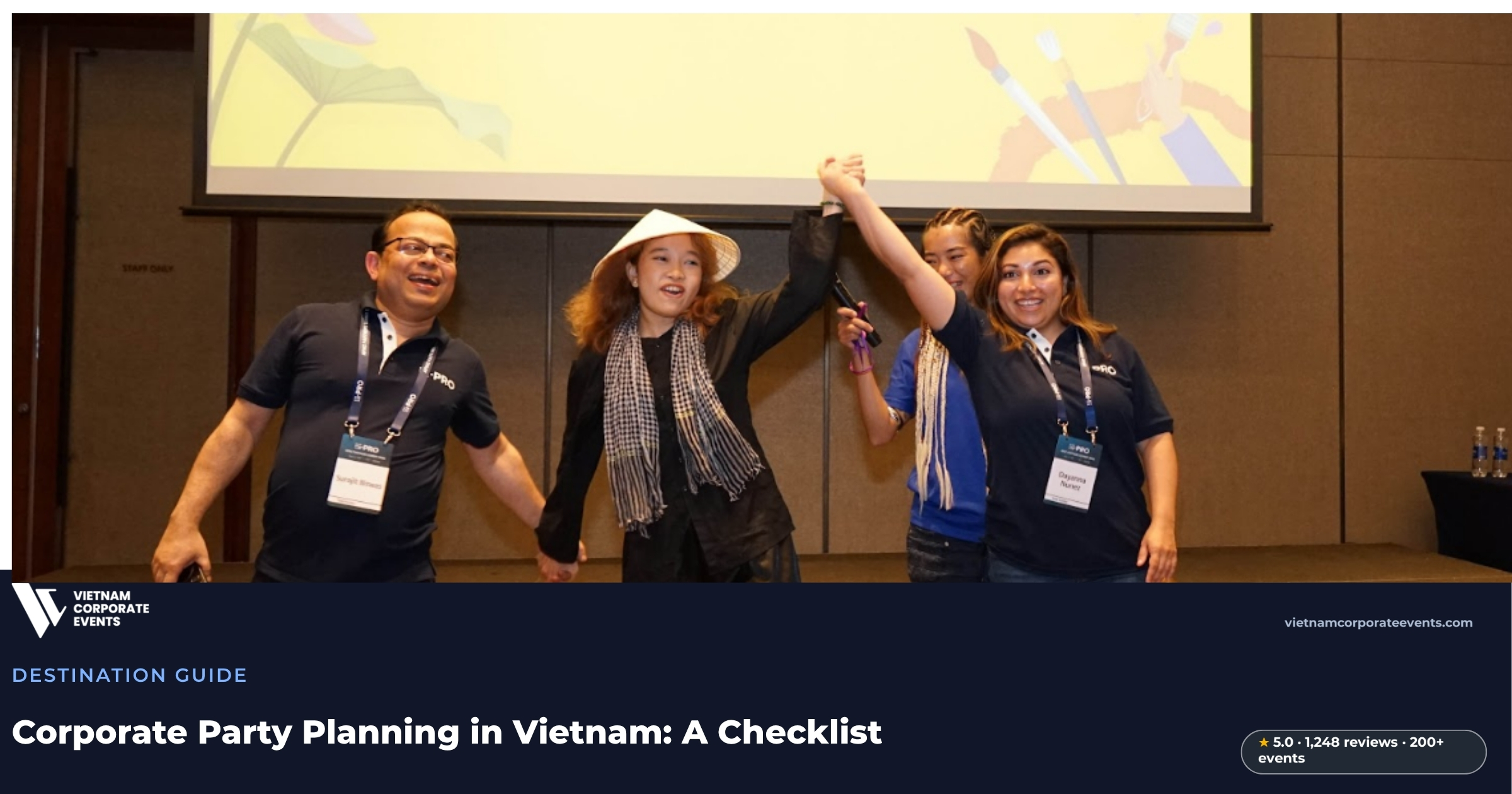
- Staff performances. Consistently the most enjoyed element when the culture supports it.
- Interactive games. Lucky draws and quizzes to break up the evening; see funny team building games.
Bilingual MCs matter in mixed-nationality companies. An evening conducted entirely in one language quietly excludes part of the room.
What details get missed?
The items that surface at the worst possible moment:
- Transport home. Particularly where alcohol is served — arrange it rather than assuming.
- A seating plan that mixes departments instead of reproducing the office floor plan.
- Awards content checked for correct spelling of every name.
- A briefed photographer with a shot list, not general coverage.
- Someone assigned to look after guests who arrive alone.
- A contingency plan for a no-show performer or AV failure.
- Alcohol pacing and a genuine non-alcoholic option that is not just water.
The name-spelling point sounds trivial and is not. Mispronouncing or misspelling an award winner’s name in front of three hundred colleagues undoes the recognition the award was meant to deliver.
How do you make it inclusive?
A party that half the company endures is worse than no party, and a few decisions prevent that.
Provide genuine non-alcoholic options rather than an afterthought, since a meaningful proportion of any workforce does not drink. Make costume elements optional in themed events. Cater properly for dietary and religious requirements without singling people out.
Consider timing too — an event finishing at midnight excludes staff with caregiving responsibilities or long commutes. An earlier, shorter party with genuine energy often reaches more of the company than a late one that only some can attend.
Sound corporate party planning Vietnam practice treats inclusion as a design input rather than a complaint to handle afterwards.
What does a corporate party cost?
Corporate party planning Vietnam costs vary enormously with format and standard, but the structure is predictable.
Per-head cost is driven mainly by venue tier and food and beverage package, with entertainment and production adding a fixed layer that spreads better across larger groups. A hundred-person party therefore costs more per head than a four-hundred-person one at the same standard.
The efficiency lever is venue choice. A venue with its own atmosphere — a rooftop, a heritage building, a beach — removes most of the decoration budget a plain ballroom requires. Model the numbers with our event planning guide.
A short example: when Aldridge & Co moved its annual party from a hotel ballroom to a riverside venue and hired a properly bilingual MC, the total spend was unchanged. The feedback difference came almost entirely from the MC, who kept the programme moving and made the awards feel significant rather than procedural.
Should you use an event planner?
For a team dinner of thirty, no. For anything above roughly a hundred guests with a programme, awards and production, usually yes.
The work involved — venue negotiation, supplier coordination, run sheet, on-night management — is substantial, and it falls on someone internally who has another job. A corporate event planner HCMC or elsewhere absorbs that and carries accountability when a supplier fails at seven o’clock.
The practical test is whether anyone internally can be genuinely off-duty on the night. If the person who organised it spends the party managing it, they have not attended their own event. See our guide to choosing an event company.
How do you handle the seating plan?
Seating is the cheapest lever available and the one most often wasted.
The default — letting people sit where they like — reproduces the office floor plan exactly. Departments cluster, the same people talk to each other, and an event intended to connect the company connects nobody new.
Assigned mixed seating solves it, and takes about twenty minutes to arrange. Balance each table across departments, seniority and tenure, and seat at least one confident conversationalist per table to carry the early awkwardness.
The one exception is partners and guests, who should be seated together with their colleague. Beyond that, deliberate mixing is the single highest-return decision in corporate party planning Vietnam, and it costs nothing at all.
Frequently asked questions about corporate party planning in Vietnam
How far ahead should you plan a corporate party?
Four to six months for most events, and considerably earlier for year-end season, when popular venues are frequently booked a year in advance.
What is the most overlooked venue check?
Kitchen plating capacity against your actual guest count. A venue that seats 400 but plates for 250 will serve a slow, cooling meal that guests at the back will notice.
When should speeches happen?
Early — between courses rather than after dessert. By the time the bar has been open two hours, no speech lands regardless of how well it is written.
What is the highest-impact booking?
A professional, ideally bilingual MC. A good MC rescues a mediocre programme, while poor sound and pacing undermine even a beautifully styled event.
How do you make a company party inclusive?
Genuine non-alcoholic options, optional costume elements, properly handled dietary and religious requirements, and a finish time that does not exclude staff with caregiving responsibilities.
Do you need an event planner?
Not for a small team dinner. Above roughly a hundred guests with a programme and production, yes — otherwise the organiser spends their own party managing it.
What should the budget prioritise?
Sound, MC and catering throughput over decoration. A well-run programme in a plain room beats a styled event where nobody can hear the awards.
Plan your corporate party
Ready to hand over corporate party planning Vietnam to someone who will run the night so you can attend it? Request a free proposal and we will handle venue, catering, entertainment and the run sheet — or explore our corporate events service and past success stories.
“