”
Incentive Travel Ideas to Motivate Your Team
Ask a sales director what their team earned in bonuses three years ago and you will get a blank look. Ask what happened on the Phu Quoc trip and you will get twenty minutes of stories.
That gap is why incentive travel ideas remain the most durable form of employee recognition available. A trip becomes a memory with photographs attached; cash becomes a line on a payslip and then a mortgage payment.
This guide covers twenty incentive travel ideas organised by concept, plus how to design qualification, avoid the common mistakes and measure whether any of it worked.
Why does incentive travel work?

Three mechanisms do the work, and understanding them helps you choose between the incentive travel ideas below.
The first is memorability — experiences are encoded differently from money and stay retrievable for years. The second is social visibility: colleagues who did not qualify watch the trip happen, which is what drives next year’s effort. The third is family effect, since a reward that reaches a partner or household carries weight a bonus rarely does.
The Incentive Research Foundation studies non-cash reward programmes specifically, and recognition consistently emerges as the active ingredient rather than the monetary value of the reward itself.
What destination-led incentive travel ideas work?

The destination is the headline, and these concepts consistently deliver:
- The island escape. Phu Quoc or Con Dao — pure reward with a genuine sense of privilege; see Phu Quoc incentive trips.
- The variety trip. Da Nang, where beach, mountain and heritage combine; see Da Nang incentive trips.
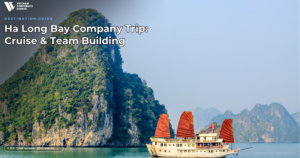
- The cruise programme. Ha Long Bay overnight, where the setting is the accommodation.
- The highland reset. Da Lat or the Central Highlands for a calmer, cooler reward.
- The multi-city tour. Two destinations linked by a short flight for longer programmes.
Among best incentive trip destinations Asia offers, Vietnam competes strongly on value — the standard of resort a given budget buys here is noticeably higher than in the region’s more established markets.
What experience-led ideas make a trip memorable?
The destination gets people excited; the experiences are what they describe afterwards:
- A private beach gala. Torches, staging and a plated dinner on the sand.
- A helicopter or seaplane transfer. A single high-impact moment that costs less than expected.
- A chef’s table dinner. An intimate, exclusive-feeling meal for smaller groups.
- Sunset yacht charter. Highly photogenic and genuinely aspirational.
- A championship golf day. A staple for senior qualifier groups.
- Cultural immersion. A Hoi An lantern evening or a hands-on cooking session.
- Spa and wellness time. Consistently the highest-rated inclusion in post-trip surveys.
The test for any of these incentive travel ideas is simple: would the qualifier pay for this themselves on holiday? If yes, it belongs in the programme.
What recognition ideas belong in the programme?
Among incentive travel ideas, recognition is where most schemes underinvest, and it is the element that converts a holiday into recognition:
- An awards dinner with individual citations. Names read out, achievements described specifically.
- A leadership presence. A senior executive attending signals the reward matters.
- Personalised gifts. Engraved or tailored rather than branded merchandise.
- A film or photo montage. The qualification year told as a story.
- A hall-of-fame element. Repeat qualifiers recognised distinctly.
Strong incentive program examples always have an explicit recognition moment. Without one, the trip is a company-funded holiday and the motivational effect largely evaporates.
What partner and family ideas should you consider?
These incentive travel ideas extend the reward beyond the employee, which changes its character entirely:
- Subsidised partner places. The most common compromise between value and cost.
- A partner activity programme. So partners are occupied during any business content.
- A family day option. Adding a day at the qualifier’s own expense.
For roles involving heavy travel, employee reward trip ideas that include a partner carry disproportionate weight — the reward reaches into home life rather than taking more time away from it.
How should qualification be designed?
For incentive travel ideas, the mechanics matter as much as the destination, and poor design wastes the whole budget.
Thresholds should be achievable by a meaningful proportion of the population — if only the top three ever qualify, everyone else disengages immediately. A tiered structure, where a larger group qualifies for the trip and a smaller group receives an upgrade, keeps more people in play.
Criteria should also be transparent and trackable in real time. People need to know where they stand while there is still time to act, which means a visible leaderboard rather than an announcement in month twelve.
Finally, avoid purely relative targets. Ranking-based qualification pits colleagues against each other, which undermines the collaboration most companies are simultaneously trying to build.
How do you communicate the programme?
Anticipation does much of the motivational work, and it is free.
Launch with the destination visible — photographs, the resort name, the outline itinerary. A programme announced as “”an incentive trip to be confirmed”” motivates nobody, because there is nothing to imagine.
Sustain visibility through the qualification period with progress updates and reminders of what is at stake. Then, afterwards, circulate the content widely: a well-photographed trip becomes the launch material for next year’s programme.
Among the incentive travel ideas here, none outperforms simply making the reward vivid and visible from day one.
What are the common mistakes?
Five recur often enough to be worth naming:
- No recognition moment. The single most common and most damaging omission.
- Over-scheduling. A packed itinerary turns a reward back into work.
- Unreachable thresholds. Qualification that only the top few can achieve.
- Wrong season. Running a beach reward during the rainy months.
- No documentation. No professional photography, so nothing to fuel next year.
The over-scheduling point deserves emphasis. Genuinely unstructured time is a feature of good employee reward trip ideas, not a gap in the agenda to be filled.
How do you measure the return?
Incentive travel is unusually measurable, because qualification data already exists.
Compare performance in the qualification period against the equivalent prior period, paying particular attention to the cohort just below the threshold — that is where the motivational effect is most visible.
Track retention of qualifiers over the following twelve months against the wider population, since these are typically the people a business least wants to lose. Then measure engagement with the next cycle: rising enquiries about qualifying is the clearest signal the programme functioned as motivation rather than merely as reward.
Model the financial side with our incentive travel cost guide and the wider category in our incentive travel guide.
What do incentive programmes cost?
Incentive travel ideas carry higher per-head costs than team-building trips, and the premium is functional — the standard is part of the reward rather than an indulgence.
Flights, four or five-star accommodation, the gala production, signature experiences and professional photography are the main drivers. Free time reduces activity spend while increasing perceived value, which is the rare inclusion that improves the programme and the budget simultaneously.
Set against retention and performance effects, well-designed incentive travel ideas generally compare favourably with an equivalent cash bonus pool. See our company trip budget guide for the full modelling.
A short example: when Coastline Mutual restructured its scheme from a top-five ranking to a threshold that around a quarter of the sales team could reach, qualification enquiries tripled and total programme cost rose only modestly — because the trip was the same trip, simply earned by more people.
How do you choose between the options?
With this many incentive travel ideas available, the shortlist should be built from constraints rather than enthusiasm.
Start with the qualifier profile. A young sales team and a group of senior account directors want genuinely different rewards — adventure and nightlife versus privacy and comfort — and designing for the wrong one wastes the budget entirely.
Then apply the practical filters: how many days can qualifiers realistically be away, what the per-head budget supports, and which season the qualification period ends in.
Only then compare destinations. Most disappointing programmes come from choosing a beautiful destination first and discovering afterwards that it does not suit the group, the calendar or the budget.
Do these programmes work outside sales teams?
Yes, and the assumption that they only suit sales is one of the more expensive blind spots in employee recognition.
Any role with measurable output can carry a qualification threshold — support teams on resolution quality, operations on safety or efficiency metrics, technical teams on delivery milestones. The criteria differ; the mechanism does not.
The effect is often stronger outside sales, precisely because these teams are rarely recognised this way. A support team that has never had a reward programme responds to one far more dramatically than a sales floor for whom incentives are routine.
The design caution is fairness. Thresholds must be genuinely achievable within each function’s own metrics rather than borrowed from the sales scheme, or the programme reads as tokenism.
Frequently asked questions about incentive travel ideas
What are the best incentive travel ideas?
Island escapes for exclusivity, variety destinations combining beach and culture, cruise programmes, and highland resets — each paired with a private gala and an explicit recognition moment.
Why is travel better than a cash bonus?
Because experiences are remembered for years while cash is absorbed into household budgets, and a trip is socially visible to colleagues, which drives future qualification.
How should qualification thresholds be set?
Achievable by a meaningful proportion of the team, transparent and trackable in real time, and based on absolute rather than purely relative targets so colleagues are not pitted against each other.
Should partners be included?
Often worth offering at a subsidised rate. It raises the perceived value substantially, particularly for roles involving heavy travel, while sharing the cost and letting qualifiers self-select.
What is the most commonly missed element?
The recognition moment. Without an awards dinner or citation ceremony where achievement is named publicly, the trip becomes a company-funded holiday rather than recognition.
How do you measure incentive programme success?
Performance against threshold versus the prior period, retention of qualifiers over the following year, and enquiry volume for the next cycle once the photographs circulate.
How much free time should a reward trip include?
At least one genuinely unscheduled block per day. Over-programming turns a reward back into work and undermines the entire premise of the incentive.
How do you choose between incentive destinations?
Start from the qualifier profile, then apply practical filters – days available, per-head budget and the season the qualification period ends in – before comparing destinations.
Do incentive trips work for non-sales teams?
Yes. Any role with measurable output can have a qualification threshold, and operations, support and technical teams often respond strongly because they are rarely recognised this way.
Plan your incentive programme
Ready to turn incentive travel ideas into a programme that actually moves performance? Request a free proposal and we will design the destination, experiences and recognition moment around your qualifiers — or explore our incentive travel service and past success stories.
“