What is escape room team building?
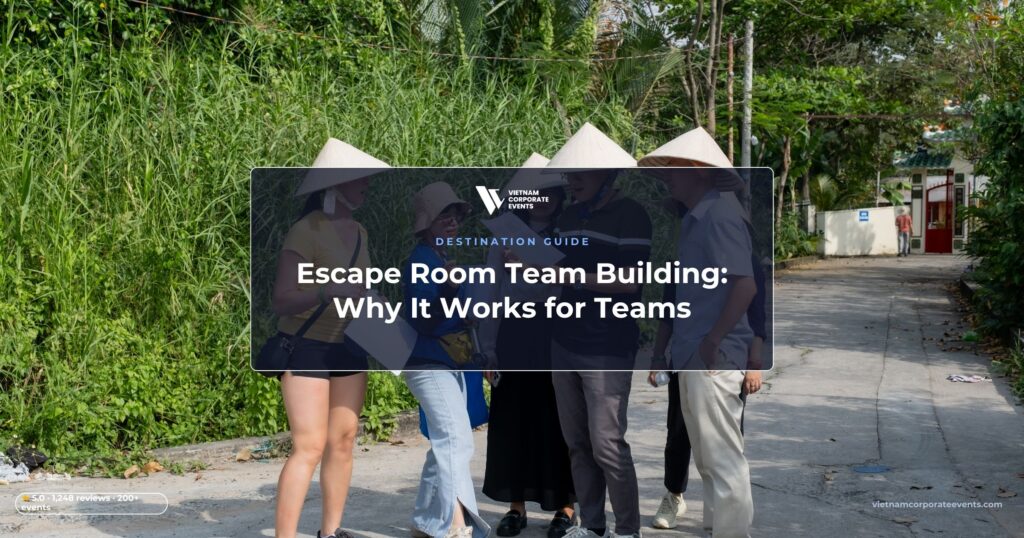
Escape room team building is a timed challenge where a team must solve a linked series of puzzles, riddles and locks to “”escape”” a themed room before the clock runs out. Success depends entirely on collaboration — no individual can crack it alone.
Unlike a casual outing to a commercial venue, a corporate escape room Vietnam program is facilitated and debriefed, so the experience becomes a lesson rather than just an hour of fun. The puzzles are the vehicle; the teamwork is the point.
The format is popular because it is intense, inclusive and fast. Everyone has a role, the clock creates real urgency, and the shared win — or near miss — bonds a group quickly.
How does an escape room challenge work?
The structure is tight by design:
- Briefing. Teams get the story, the rules and the time limit — usually 45 to 60 minutes.
- The clock starts. Teams search the room, find clues and solve linked puzzles.
- Progression. Each solved puzzle unlocks the next, building toward the final lock.
- The finish. Teams escape — or run out of time — and the result is scored.
- Debrief. A facilitator unpacks how the team communicated, delegated and decided under pressure.
That debrief is what elevates the experience above a night out. The room shows a team its own habits; the debrief turns those habits into a conversation.
What does an escape challenge develop?
A good escape room stress-tests the exact skills that matter at work:
- Communication. Information is scattered, so teams must share it fast and clearly.
- Delegation. With many puzzles at once, teams that split up win.
- Leadership. Someone must coordinate without controlling — a live leadership lesson.
- Problem-solving under pressure. The clock forces decisions with incomplete information.
- Trust. Members must rely on each other’s discoveries to progress.
Research bodies such as SHRM consistently link these shared, high-engagement experiences to stronger team cohesion — and few formats surface them as vividly as an escape challenge.
What escape room formats are available in Vietnam?
Beyond fixed commercial venues, corporate escape experiences come in several flexible formats:
- Themed commercial rooms. Purpose-built rooms with rich sets, ideal for smaller teams.
- Mobile and pop-up escape rooms. Brought to your hotel or venue for on-site convenience.
- Portable puzzle-box formats. Tabletop escape kits that scale to dozens of teams at once — perfect for conferences.
- Story-led corporate editions. Custom narratives built around your brand, values or event theme.
The portable and box formats are what make an indoor escape game corporate program scale to a large conference room, not just a two-team venue. For the full menu of games, see our team building games ideas pillar.
What group sizes suit escape room team building?
Traditional rooms take small teams of 4 to 8, so larger groups run multiple rooms or portable box formats in parallel. Mid-size groups of 30 to 60 split into competing teams racing the same challenge.
For 100-plus at a conference, tabletop escape kits let dozens of teams play simultaneously on a shared timer and leaderboard. The competitive, parallel setup keeps a big room fully engaged — a strong option alongside our indoor team building activities.
Where can you run a corporate escape room in Vietnam?
Because mobile and box formats travel, an escape challenge runs almost anywhere — a Ho Chi Minh City hotel, a Da Nang resort, or a Hanoi conference venue. City teams often pair it with other formats.
- Ho Chi Minh City — see our Saigon team building activities.
- Da Nang — pair with a beach day; see Da Nang team building.
- Hanoi — a strong rainy-season choice; see Hanoi team building.
How much does an escape room challenge cost?
Cost depends on the format, whether it is a fixed venue or brought on-site, and group size. Commercial rooms are priced per team, while portable and box formats scale efficiently for large groups, lowering the per-person rate.
A half-day corporate escape program is mid-range among team-building formats — good value given the depth of insight it delivers. A local organiser quotes by headcount and format; model it inside a wider program with our company trip budget guide.
Escape room or Amazing Race: which should you choose?
Both build teams under pressure, but the experience differs. An escape room is intense, indoor and cerebral — deep problem-solving in a confined space. An Amazing Race is expansive, outdoor and physical — fast movement across a city.
| Aspect | Escape room | Amazing Race |
|---|---|---|
| Setting | Indoor, contained | Outdoor, city-wide |
| Pace | Intense, focused | High-energy, mobile |
| Best for | Communication, pressure | Energy, decision-making |
Choose an escape room for a focused, weather-proof challenge, and an Amazing Race for high-energy movement. Many offsites run both across a day.
A short case study: pressure reveals the team
When Meridian Pay ran an escape room team building session for a newly merged 40-person department, the revealing moment was not the escape — it was watching two sub-teams hoard clues instead of sharing them. In the debrief, that behaviour mapped exactly onto a real cross-team silo the managers had been struggling to name. The room gave them the language to fix it.
How do you design a corporate escape room program?
A corporate program is more than a booking at a commercial venue. The design choices that make it worthwhile are the ones a casual outing skips.
- Add a facilitator. Someone to observe the dynamics and lead a debrief afterward.
- Run multiple rounds. Two or three shorter challenges reveal more than one long one.
- Choose an inclusive puzzle mix. Logic, observation, wordplay and physical tasks so everyone contributes.
- Tie it to a goal. Onboarding, communication or leadership — the objective shapes the debrief.
The puzzles are the vehicle; the reflection is the value. A well-designed program leaves a team talking about how it works, not just whether it escaped.
How do you run an escape challenge for a conference?
For a large conference, fixed rooms do not scale — but portable and tabletop formats do. Dozens of teams play the same challenge simultaneously on a shared timer and leaderboard, turning a ballroom into a competitive arena.
The energy of a full room racing the same clock is hard to match, and the shared debrief afterward gives a big group a common reference point. It is one of the most engaging ways to break up a day of sessions and pair with our indoor team building activities.
Common escape room mistakes to avoid
Three recur. Booking a purely commercial room with no facilitation, so the experience stays entertainment. Choosing puzzles that reward one type of thinker, sidelining the rest of the team. And skipping the debrief, which is where the insight actually lives.
Avoid those three and an hour in a locked room becomes one of the sharpest team diagnostics you can run — fast, memorable and genuinely revealing.
Why do teams remember an escape challenge?
Because it is intense, shared and revealing all at once. Sixty pressured minutes create a vivid, common memory — the moment a clue finally cracked, the near-miss on the clock, the teammate who quietly held the group together.
That shared story is what bonds a group, and the behaviours it surfaces are real. Under time pressure, people revert to their true working styles, so managers see how their team actually communicates, delegates and decides — insight no survey delivers.
The format also travels well across cultures and languages, since the puzzles rely on logic and observation as much as words. For a mixed international team, that makes it one of the most inclusive high-engagement formats available, alongside our wider games menu.
Can an escape challenge be run virtually?
Yes. Virtual and hybrid escape challenges let remote or distributed teams solve a shared digital puzzle against the clock, which makes the format useful well beyond a single room.
A facilitator hosts online, teams work in breakout groups, and the same dynamics — communication, delegation, decisions under pressure — still surface. For a hybrid workforce, it is one of the few formats that keeps everyone genuinely engaged on a screen.
That said, an in-person challenge remains the stronger reset for team cohesion, because the shared physical space and the ticking clock in the room create an intensity a screen struggles to match. Many companies use virtual editions to stay connected between in-person offsites.
What themes work for a corporate escape room?
A strong theme sharpens the experience and can tie it to your goals. The most effective corporate themes range from classic mystery and heist narratives to branded scenarios built around a company’s own story or product.
For onboarding, a theme woven around company history and values doubles as culture-building. For a product team, a scenario mirroring a real project challenge makes the lessons land harder. The narrative is not decoration — it is what makes the hour feel bespoke rather than off-the-shelf, and it gives the debrief a clearer link to work.
Frequently asked questions about escape room team building
How long does an escape room session take?
The challenge itself runs 45 to 60 minutes, with a full program lasting two to three hours including briefing, multiple rounds and a debrief.
How many people can do an escape room together?
Traditional rooms suit 4 to 8 per team; larger groups run parallel rooms or portable box formats that scale to 100-plus at a conference.
Is escape room team building good for large groups?
Yes, with the right format. Tabletop and portable escape kits let dozens of teams play at once on a shared timer and leaderboard.
Do you need to be clever to enjoy an escape room?
No. Puzzles span logic, observation, wordplay and physical tasks, so different strengths contribute — that variety is the point.
Can an escape room be branded to our company?
Yes. Story-led corporate editions build the narrative and puzzles around your brand, values or event theme.
Put your team to the test
Want to see how your team really works under pressure with escape room team building? Request a free proposal and we will bring the right format to your team and group size — or explore our team building service and past success stories.
“