What makes a team building game actually work?
Three things separate a game that builds a team from one that just fills an hour. A clear objective, so the activity has a point. A shared challenge, so people have to rely on each other.
And a debrief, so the lesson transfers back to work. Skip the debrief and even the best game is just fun; include it and a 20-minute activity becomes a genuine development tool. That is the principle behind every one of these team building games ideas.
What are the best team building games for building trust?
Trust games work best for new, merged or remote-heavy teams. These four are our reliable openers:
- Blindfold navigation. One player crosses a course guided only by teammates’ voices — pure trust and clear communication.
- The minefield. Teams guide a blindfolded partner through an “”obstacle field”” using instructions alone.
- Human knot. A tangled circle must unravel without letting go — cooperation under mild chaos.
- Back-to-back drawing. Partners recreate a drawing using description only, exposing how assumptions break communication.
Which games improve communication?
Communication games surface how information gets lost — and how to fix it. These are strong fun team building games for any office team:
- Telephone charades. A message passed through mime, growing funnier and more distorted at each step.
- The spec build. One team describes an object; another builds it blind from the description alone.
- Escape room. Timed puzzles that force a team to pool information fast.
- Code relay. Teams decode and pass a message accurately against the clock.
What games sharpen problem-solving?
Problem-solving games mirror real work: incomplete information, a deadline, and no single person who can win alone.
- Bridge or marshmallow build. Teams build the tallest or strongest structure from limited materials.
- Survival scenario. Groups rank items to “”survive,”” negotiating priorities under pressure.
- Treasure hunt. A clue-based challenge rewarding division of labour.
- Amazing Race. A city-wide, checkpoint-based race; see our Amazing Race team building guide.
What high-energy games work for large groups?
For big groups, energy and scalability matter most. These team building games for large groups keep hundreds active at once:
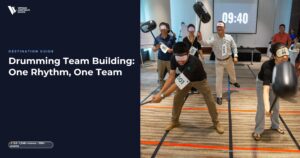
- Interactive drumming. A whole room finds one rhythm — scales to 500-plus.
- Beach Olympics. Parallel stations with a shared scoreboard; see our beach team building menu.
- Indoor mini-Olympics. A circuit of quick games for mixed fitness levels.
- Tug-of-war. The classic leveller, ideal as an opener or finale.
- Human bingo. A fast networking icebreaker for large conferences.
- Group juggle. A name-and-throw sequence that scales and warms up a big room.
- Flash-mob challenge. Teams learn and perform a routine — a high-energy finale.
- Team trivia. A big-group favourite that closes an event on a competitive high.
Which game fits your team? (by size and goal)
Use this quick matrix to shortlist:
| Goal \ Size | Small (10–40) | Large (100+) |
|---|---|---|
| Trust | Blindfold navigation, human knot | Group juggle, drumming |
| Communication | Spec build, escape room | Human bingo, telephone charades |
| Problem-solving | Marshmallow build, survival | Amazing Race, treasure hunt |
| Energy | Mini-Olympics, tug-of-war | Beach Olympics, flash-mob |
For city-based programs, our team building activities in Ho Chi Minh City put many of these games into a real Saigon setting.
How do you run a game so the lesson lands?
The game is only half the value; facilitation is the other half. Brief clearly, keep rounds tight, and always close with a debrief that connects what happened to how the team works.
A short example: when Lumera ran a problem-solving relay, the winning team was not the fastest — it was the one that split into pairs to work in parallel. In the debrief, that became a lasting metaphor for how the company tackled projects: divide, trust, reconverge. Research from SHRM consistently links these shared, active experiences to stronger engagement.
Indoor or outdoor: which should you choose?
Both work; the choice comes down to season, group energy and the outcome you want. Outdoor games immerse the team and build fast, shared adrenaline. Indoor games offer control, comfort and reliability whatever the weather.
| Factor | Outdoor games | Indoor games |
|---|---|---|
| Energy | High, physical | Focused, controlled |
| Weather risk | Higher | None |
| Best for | Reward, bonding | Workshops, conferences |
The strongest programs blend both — an indoor icebreaker, an outdoor main event, and an indoor close.
What are good virtual team building games?
Hybrid and remote teams still need connection, and several formats translate well to a screen. The strongest virtual team building games ideas keep everyone active rather than watching.
- Online escape room. A shared digital puzzle solved against the clock.
- Virtual trivia. Fast, competitive rounds that suit large distributed teams.
- Show-and-tell challenges. A quick personal round that builds human connection.
- Collaborative drawing or build. A shared creative task using an online whiteboard.
Virtual formats are a useful supplement, but for a real reset most teams still benefit from getting together in person at least once or twice a year.
How do you pick games for an offsite versus a conference?
Context changes the choice. An offsite has time and space for longer, immersive games — an Amazing Race, a full problem-solving build, a beach Olympics. The goal is depth and shared experience.
A conference needs short, high-energy formats that slot between sessions — energisers, trivia, human bingo — to fight the post-lunch slump without derailing the agenda. The best team building games ideas for a conference are the ones that reset energy in ten minutes, not two hours.
Which classic team building games should you avoid?
Not every well-known game earns its place. A few to retire or handle with care:
- The literal trust fall. High injury risk, low real payoff — the metaphor works better than the exercise.
- Forced personal sharing. Games that pressure people to overshare create discomfort, not trust.
- Elimination games. Anything that leaves people sitting out for long stretches drains energy.
- Overly competitive formats that fracture rather than unite the group.
The test is simple: does the game include everyone and build the team, or does it single people out? Good facilitation is what keeps even a familiar game on the right side of that line.
How do you debrief a team building game?
The debrief is where a game becomes a lesson, yet it is the step most often skipped. Done well, a ten-minute conversation turns a fun activity into a genuine development moment.
Keep it simple with three questions: what happened, what worked, and what does it mean for how we work? Let the team surface the insights rather than lecturing them — the lesson sticks far better when it comes from the group.
Then connect it forward. If a game rewarded clear communication or quick delegation, name the moment and link it to a real work situation. The strongest team building games ideas are chosen precisely because their lesson transfers — a problem-solving relay teaches how the team tackles projects, a trust game teaches how it handles risk.
Skip the debrief and you have entertainment; include it and you have a tool. Our facilitators build reflection into every program by default — see the full team building service.
How many games should a team building session include?
More is not better. A session crammed with games leaves no time for the reflection that makes them worthwhile, and it exhausts the group.
For a half-day program, three to four well-chosen games with proper debriefs work far better than eight rushed ones. Build an arc: an easy icebreaker to warm the room, a main problem-solving or communication challenge, and a high-energy finale to end on a high.
Vary the type, too. Mixing a physical game, a mental challenge and a creative task means every personality gets a moment to contribute — the quiet analyst and the energetic extrovert both shine somewhere. The best team building games ideas are sequenced deliberately, not stacked at random.
Leave breathing room between activities for transitions and reflection. A session that races from game to game feels frantic; one with a clear rhythm feels intentional, and the lessons actually land. Our facilitators design that rhythm into every team building program.
What outcomes should you expect from a games session?
A well-run session is not just a fun afternoon — it should leave the team measurably better connected. In the short term, expect higher energy and easier communication in the days that follow.
Over weeks, the behaviours the games rehearsed — faster delegation, clearer listening, more cross-team trust — start showing up in real work, provided the debrief made the link explicit. The best team building games ideas are chosen because their lesson transfers, so the return on a half-day is a team that works together a little more smoothly on every project after it.
Frequently asked questions about team building games ideas
What are the best team building games for the workplace?
It depends on your goal. For trust, blindfold navigation; for communication, the spec build; for problem-solving, an Amazing Race — the best team building games ideas are matched to the outcome you need.
What team building games work for large groups?
Interactive drumming, beach Olympics, human bingo and team trivia scale to hundreds while keeping everyone active.
How long should a team building game take?
Most run 15 to 45 minutes, plus a short debrief. A half-day program strings several together with a clear arc.
Do team building games work for remote or hybrid teams?
Yes — many trust and communication games adapt to virtual formats, and in-person events remain the strongest reset for hybrid teams.
What makes a team building game effective?
A clear objective, a genuine shared challenge, and a debrief that connects the game to how the team works day to day.
Are team building games suitable for senior leadership teams?
Yes, with the right choice. Senior teams respond best to strategic problem-solving and communication games followed by a substantive debrief, rather than high-energy physical formats aimed at larger groups.
Bring these games to your team
Want these team building games ideas run properly, with real facilitation and a debrief that sticks? Request a free proposal and we will build a program around your team’s goal and size — or explore our team building service and past success stories.
“